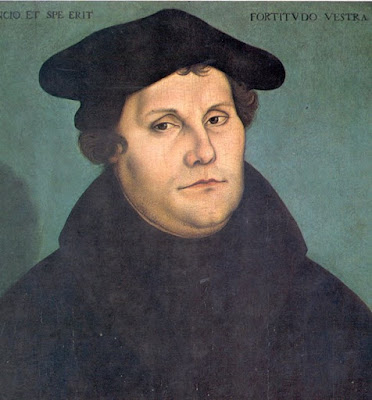
-Wir sein pettler. Hoc est verum.--"We are beggars. This is true."--Martin Luther-

_______________________________________________
[ Home ] [ Originals ] [ Words of Ones Wiser ] [ Odds and Ends ]
Showing posts with label Word and Sacrament. Show all posts

Wednesday, January 21, 2009

Lutheran Quote of the Day: Bayer on the Performative Nature of God's Word

"Luther also discovers this kind of performative word in the sacraments of Baptism and the Lord's Supper, as well as in the Christmas story ("To you is born this day a Savior!"), the Easter story, and many other biblical passages. As we have said before, he regards these sentences as promises (promissiones). They are the concrete way in which Christ is present, and his presence with us is clear and certain: it clearly liberates us and makes us certain. I cannot remind myself of this freedom and certainty in isolation; I cannot have a monologue with myself. These gifts are given and received only by means of the promise spoken by another person (and not only by the official priest or preacher), who addresses it to me in the name of Jesus. I cannot speak the promise to myself. It must be spoken to me. For only in this way is it true. Only in this way does it give freedom and certainty.

"What this certainty is all about is clear from a short passage in the Lectures on Genesis that Luther virtually offers as a theological legacy: "I have been baptized. I have been absolved. In this faith I will die. No matter what trials and problems confront me, I will not waver in the least. For he who said: 'The one who believes and is baptized will be saved' (Mark 16:16), and 'whatever you loose on earth will be loosed in heaven' (Matt. 16:19), and 'this is my body; this is my blood which is shed for you for the forgiveness of sins' (cf. Matt. 26:26,28), cannot lie or deceive. This is certainly true." In the Lectures on Galatians (1535) Luther writes, "And this is the reason why our theology is certain: it snatches us away from ourselves and places us outside ourselves (nos extra nos), so that we depend not on our own strength, conscience, mind, person, or works but on what is outside ourselves (extra nos), that is, on the promise and truth of God, which cannot deceive.""

-Oswald Bayer, Theology the Lutheran Way, trans. Jeffrey Silcock and Mark Mattes (Grand Rapids, MI: Wm. B. Eerdmans Publishing, 2007), 130.

Monday, January 19, 2009

Lutheran Quote of the Day: Bayer on Faith and the Promises of God

I thought this bit from Oswald Bayer's, Theology the Lutheran Way, went well with my previous post, Faith and the Promises of God. In it Bayer affirms the basic structure of a proper relationship before God, that is, in God's self-giving through the Word of promise and our receiving through the open hands of faith. This is what Bayer calls the vita passiva, the receptive life.

"Everything depends on God's performative word for the enactment of the promise of the forgiveness of sins and the healing of our ingratitude towards our creator. Since this word precedes our faith, our response of faith and prayer can never lead us to understand the divine service as a "self-realization of the church." Even as the response of the church faith remains God's work.

"The standard arguments from ecclesiology and sacramental theology resort to the category of "representation," and speak of the "self-realization of the church" and of the church as the "original sacrament." It is clear from this that the criterion of the particular divine service, which Luther vigorously promoted from the beginning of his Reformation theology, is not at all self-evident. For him, worship has to do with the enactment of the word and faith, of promissio and fides. This is classically formulated in the treatise, The Babylonian Captivity of the Church (1520): "For God does not deal, nor has he ever dealt, with us except through the word of promise. We, in turn, cannot deal with God except through faith in the word of his promise." This asymmetrical correlation between word and faith, where the word always comes first and faith follows the word, is for Luther the criterion of the true divine service. At the end of his life he preached a sermon at the consecration of the castle church in Torgau in 1544. There he gave his famous definition of the divine service that beautifully exemplifies this criterion. He calls on the people to join him in the consecration "in order that the purpose of this new house may be this: that nothing else may happen in it except that our dear Lord himself may speak to us through his holy word and that we respond to him through prayer and praise.""

-Oswald Bayer, Theology the Lutheran Way, trans. Jeffrey Silcock and Mark Mattes (Grand Rapids, MI: Wm. B. Eerdmans Publishing, 2007), 88-89.

Sunday, January 18, 2009

Faith and the Promises of God

From what we read below, in my post Faith, Healing, Prayer, and Miracles in the Gospels, we see a few things that stick out:

Jesus in a couple of places gives a dual structure: in the first point "as you have believed (πιστεύω)," in the second, "so let it be to you" (cf. Matt. 8:13; 9:29).

Many other times, Jesus says, "ἡ πίστις σου σέσωκέ σε," that is, "The (ἡ) faith (πίστις) of you (σου) has healed (σέσωκέ) you (σε)" (Matt. 9:22; Mark 5:34; 10:52; Luke 8:48; 17:19; 18:42).

Other examples we hear: "great is your faith; let it be to you as you desire" (Matt. 15:28); "If you are able to believe, all things are possible to the ones believing" (Mark 9:23); "Do not fear; only believe and she will be healed" (Luke 8:50).

On the reverse side of this we hear from Matthew and Mark, of the same account, what happened when people did not believe Jesus' witness: "He did not do many works of power there because of their unbelief" (Matt. 13:58); "He could do no work of power there, except He performed healing on a few infirm ones, laying on His hands" (Mark 6:5).

We also see examples where we are led to believe that if one has faith, that one can do great things:

We read the account of Peter who, when asked to step out on the water, loses faith and starts sinking; Jesus says, "Little-faith, why did you doubt?" (Matt. 14:31).

We hear of the account of the disciples not being able to exorcize a demon; they ask, "Then coming up to Jesus privately, the disciples said, Why were we not able to cast him out? And Jesus said to them, Because of your unbelief" (Matt. 17:19-20).

Jesus says that if we had faith of a mustard seed we would be able to move mountains and throw them into the sea, curse fig trees and have them dry up, uproot sycamore trees and plant them in the sea (cf. Matt. 17:20; 21:21; Mark 11:23; Luke 17:6).

Jesus also tells us, "All things, whatever you ask, praying, believe that you will receive, and it will be to you" (Mark 11:24; cf. Matt. 21:22). As James (and James 8^j) reminds us, "If any of you lacks wisdom, let him ask God, who gives generously to all without reproach, and it will be given him. But let him ask in faith, with no doubting, for the one who doubts is like a wave of the sea that is driven and tossed by the wind. For that person must not suppose that he will receive anything from the Lord; he is a double-minded man, unstable in all his ways" (1:5-8).

I'm not concerned with the "miraculousness" of these examples, this is beside the point. What I want to get at is whether or not this portrayal of faith is the same as the Pauline portrayal and the Lutheran understanding of faith?

As for the second part of the question, whether this is consistent with the Lutheran understanding of faith, I think the answer is, unfortunately, no. As Lutherans, we often have a knee jerk reaction to anything that might make faith out to be a work. This is good, as far as it goes, but it often 1) doesn't get the full picture, and 2) leaves us scratching our heads when confronted with such verses from the Gospels. Lutherans say that faith is purely passive, and it is, but when we look at these examples things seem to get a little muddled. We can only be healed if we have faith? If, and only if, we have enough faith we can 1) walk on water, 2) exorcize demons, 3) throw mountains into the sea, 4) get what we pray for? Lutherans usually don't like talking about faith in a qualitative way; we talk about faith as that which receives God's grace of forgivness and salvation, and it would seem, nothing more. Indeed, this is certainly St. Paul's emphasis on his teachings on faith. But is it the whole story?

As far as a qualitative understanding of faith, we as Lutherans ask: How can it all remain a gift from God (i.e. healing, water-walking, mountain-throwing, etc.) if it becomes dependent on something qualitative in me, that is, faith? For this reason we simply say: faith is faith is faith, it is purely a gift from God. The problem is when we read in the Gospels, and it is brought into question: is it enough faith for healing? enough faith for walking on water? enough faith for exorcizing demons? enough faith for my prayer to be answered? We say in response: "If God wants to ______ he will do it, it is not dependent on me, he is certainly powerful enough. If he WANTS to do it, who am I to change his mind?"

In younger days when faced with this question I settled it in my mind, saying simply that: sometimes God makes the choice only to heal/answer prayer/etc. when there is an expression of faith. That is, sometimes he just heals to heal, while at other times he chooses to heal those who have a strong faith. So what Jesus would essentially be saying is: "I decided, this time, to heal you because of your faith." Just as he might have said at another time: "I decided to heal you because of your love/hope/(insert virtue here)."

This answer, though, simply does not fly. First off, why does Jesus repeat, "your faith has healed you," over, and over, and over? Secondly, why faith? Why does Jesus continually say "faith," not love, not hope, not ____? This second question is the kicker for me. It becomes clear that faith is not an arbitrary choice by Jesus, easily replacable by any other virtue. So the first major question, which we will get back to, is, why faith?

A second problem is: Yes, okay, faith. But certainly God heals/answers prayers/etc. in certain situations even without strong faith, right? He is not bound by our faith, right? And the more disturbing question: "God's not holding back on me, not answering my prayer/healing me/etc., because of a lack of faith, is he?" These can be very disastrous questions for people. They are questions, also, that don't have a ready answer in any given situation because, simply, we don't know the mind of God. My own general answers to these questions would be as follows: 1) Yes, God can and does do these things even without strong faith. 2) No, God is not bound by our faith. 3) We don't know the mind of God; it may not be his will to answer your prayer, etc., in the first place.

All of these questions, though, miss the point. They also miss the point of, why faith? They are questions that are focussed on me, not on God and his promises.

Paul Althaus once wrote (I'm not sure where), "I do not know whether I believe, but I know in whom I believe, and only thus do I know that I believe." The answer is God and his promises through his Word and Sacraments. What needs to be understood is that the basic and originally intended structure of our relationship before God was in God's self-giving through his Word and our receiving through the open hands of faith. This is a pretty basic understanding for Lutherans and is fundamental to understanding Paul: "We have also obtained access by faith into this grace in which we stand" (Rom. 5:2). Therefore, whenever God gives through the open hands of our faith, this is a restoration of God's original will for creation. We see then, when Jesus says, "your faith has healed you," he is affirming the structure which God originally intended.

But the fact that God desires to give through faith does not mean that we should internalize everything and begin to wonder if we have enough faith; undoubtedly the answer we will find is, no, we don't. The point of faith is the promise, not ourselves. We repeat with Althaus: "I know in whom I believe, and only thus do I know that I believe." Left to ourselves we will never have a satisfactory answer. For this reason we look to the promises of God, including faith itself. We therefore pray with the apostles, "Give us more faith" (Luke 17:5); and elsewhere, "Lord, I believe! Help my unbelief!" (Mark 9:24). Or, as Luther put it, "Pray God that he may work faith in you. Otherwise you will surely remain forever without faith, regardless of what you may think or do." (LW 35:371)

A proper understanding of all the examples cited at the beginning is to understand not faith, but promise. If it was a failed faith, Jesus says: "what about my promise?" (e.g. Peter walking on the water, or the disciples' inability to cast out a demon); or, if it was strong faith, we clearly see displayed the faith these people had in Jesus' witness and promise (e.g. "Your faith has healed you).

It is only when we realize that we can accomplish nothing of ourselves, that all the fear and torment of self-reflection and internalization ceases. Faith itself is a product of God's promise through the Word, not of ourselves. As Werner Elert characterized it, faith is an "infinite resignation." We need to realize that we are just like the sick coming to Jesus. They had absolutely no power over their situations--they were infirm, poor, and had no hope that anything would better their lot-- all they had was a promise of a man who was healing the sick.

May we all become more like Abraham, the father of faith, who "did not stagger by unbelief at the promise of God, but was empowered by faith, giving glory to God, and being fully persuaded that what [God] has promised, He is also able to do" (Rom. 4:20-21).

Friday, January 9, 2009

The Indicative and Imperative Nature of Faith and New Life

This is a section out of my senior thesis on sanctification. What it addresses is the seemingly conflicting scriptural portrayal of rebirth and renewal as being, at one time, solely the work of God, and at another, an imperative placed on man to conform to God's will. It is a matter of resolving indicative and imperative. Various Lutherans have addressed this issue, namely, Paul Althaus, Helmut Thielicke, Adolf Köberle, and to a certain extent, David Scaer. Helmut Thielicke, though, is the one who really hits the nail on the head in the first volume of his Theological Ethics. I have previously written on this topic in my post The Word, Communication, and Sanctification.

We heard a little on this topic from Paul Althaus in the post Althaus on Faith and Command. There are a couple of things in his portrayal that are not quite correct. 1) Althaus talks of: "Insofar as it is God's gift." When talking of indicative and imperative, we cannot say: insofar as it is indicative/ insofar as it is imperative. We have to affirm that it is, at the same time, fully indicative and fully imperative. 2) Another problem with Althaus' portrayal is that he talks of rebirth and renewal (faith and new life) as being, from the standpoint of God, indicative, and from the standpoint of man, imperative. Indicative and imperative is not a matter of perspective, as if man simply acts and thinks as if it were all his work, while in reality it being solely the work and fruit of God. Paul makes it clear that when man acts in autonomy from acknowledgment of his total reliance on God's grace, he acts in rebellion to God. We hear from Paul:

"Work out your own salvation with fear and trembling, for it is God who works in you, both to will and to work for his good pleasure" (Phil. 2:12-13).

"So, then, it is not of the one willing, nor of the one running, but of the One showing mercy, of God" (Rom. 9:16).

God tells us: "My grace is sufficient for you, for My power is perfected in weakness" (2 Cor. 12:9).

When God says "weakness," he does not mean, those who are especially deficient in themselves, rather those who recognize that without Christ, the Vine, they can do nothing (John 15:5). But we, at the same time affirm, "[We] can do all things through him who strengthens [us]" (Phil. 4:13). When we look at the subject of Christ's beatitudes compared to, say, the Pharisees, the difference is not that the Pharisees are stronger, etc., rather, it is the poor in spirit, the mourning, the meek who recognize their total dependence on God's grace, this is why they are called blessed; we are all πτωχοι, literally, beggars in spirit, and yet, in this, we are blessed!

The Lutheran understanding of faith is a perfect example of the indissoluble connection of indicative and imperative. Emil Brunner writes: "The Word of God and the word of faith are inseparable. It is not God who believes but I myself who believe; yet I do not believe of myself, but because of God's speech." (Man in Revolt: A Christian Anthropology, trans. Olive Wyon (Cambridge: Lutterworth Press, 2002), 67.) Faith is at one and the same time completely the work and fruit of the Spirit of God, working through the Word, and yet, it is also my response to God's Word, God's claim on me. Faith is never, whether at the outset, in the midst, or at the end, a fruit of anything that is in me, and yet it is I who believe, it is I who say "yes." The Formula of Concord can even say that we "accept the offered grace." (SD Art. II, Par. 83) This is not inappropriate language if, and only if, the relation of indicative and imperative are understood correctly.

(You are not able to read this from a feed, you must come to the blogspot site.)
The Indicative and Imperative Nature of Sanctification

Thursday, December 25, 2008

The Gospel of John and the Sent One

This is a little focused word study devotional on Christ being sent into the world.

Though it may not have an infancy narrative, the Gospel of John is about as "down to earth" as you can get. One way Saint John does this is through emphasizing that Christ was sent (the Gospel of John uses both these terms: ἀποστέλλω and πέμπω) into this world. The other Gospels only have a couple of instances where Christ is said to be sent into the world (Matt. 10:40; Mark 9:37; Luke 9:48; Luke 10:16). The Gospel of John, on the other hand, has dozens and dozens of instances where Christ emphasizes this.

One of the most important reasons for this emphasis is that Christ's incarnation reveals the will of the Father towards mankind; you cannot know the Father unless through his Son. As Oswald Bayer writes: "The office of Christ is to make us certain of God." Jesus says:

"If God were your Father, you would love Me, for I went forth and have come from God. For I have not come from Myself, but that One SENT Me. Why do you not know My speech? It is because you are not able to hear My Word. You are of the Devil as father, and the lusts of your father you desire to do. That one was a murderer from the beginning, and he has not stood in the truth, because there is no truth in him. When he speaks a lie, he speaks from his own, because he is a liar, and the father of it. And because I speak the truth, you do not believe Me. Who of you reproves Me concerning sin? But if I speak truth, why do you not believe Me? The one who is of God hears the Words of God; for this reason you do not hear, because you are not of God" (John 8:42-47)

And elsewhere:

"But I have the greater witness than John's, for the works which the Father has given Me, that I should finish them, the works which I do, themselves, witness concerning Me, that the Father has SENT Me. And the Father, the One SENDING Me, has Himself borne witness concerning Me. You have neither heard His voice at any time, nor have you seen His form. And you do not have His Word abiding in you, for the One whom that One SENT, this One you do not believe. You search the Scriptures, for you think in them you have everlasting life. And they are the ones witnessing concerning Me. And you are not willing to come to Me that you may have life. I do not receive glory from men; but I have known you, that you do not have the love of God in yourselves. I have come in the name of My Father, and you do not receive Me. If another comes in his own name, you will receive that one. How are you able to believe, you who receive glory from one another, and the glory which is from the only God you do not seek? Do not think that I will accuse you to the Father; there is one accusing you, Moses, in whom you have hoped. For if you were believing Moses, you would then believe Me; for that one wrote concerning Me. But if you do not believe his writings, how will you believe My Words?" (John 5:36-47)

It is only through Christ that we truly see the will of the Father:

"For God so loved the world that HE GAVE HIS ONLY BEGOTTEN SON, that everyone believing into Him should not perish, but have everlasting life. For God did not SEND His Son into the world that He might judge the world, but that the world might be saved through Him. The one believing into Him is not condemned; but the one not believing has already been condemned, for he has not believed into the name of the only begotten Son of God" (John 3:16-18).

"Jesus answered and said to them, This is the work of God, that you believe into Him whom that One SENT" (John 6:29).

"All that the Father gives to Me shall come to Me, and the one coming to Me I will in no way cast out. For I HAVE COME DOWN OUT OF HEAVEN, not that I should do My will, but the will of Him who SENT Me. And this is the will of the Father SENDING Me, that of all that He has given Me, I shall not lose any of it, but shall raise it up in the last day. And this is the will of the One SENDING Me, that everyone seeing the Son and believing into Him should have everlasting life; and I will raise him up at the last day" (John 6:37-40).

"But Jesus cried out and said, The one believing into Me does not believe into Me, but into the One SENDING Me. And the one seeing Me sees the One who SENT Me. I have come as a Light to the world, that everyone who believes into Me may not remain in the darkness. And if anyone hears My Words and does not believe, I do not judge him; for I did not come that I might judge the world, but that I might save the world. The one who rejects Me and does not receive My Words has that judging him: the Word which I spoke, that will judge him in the last Day. For I did not speak from Myself, but He who SENT Me, the Father, He has given Me command, what I should say, and what I should speak. And I know that His command is everlasting life. Then what things I speak, as the Father has said to Me, so I speak" (John 12:44-50).

And John writes in his first epistle:

"By this the love of God was revealed in us, because His Son, the Only begotten, God has SENT into the world that we might live through Him. In this is love, not that we loved God, but that He loved us, and SENT His Son to be a propitiation relating to our sins" (1 John 4:9-10).

It is through Christ's incarnation that we truly see that God is love; that he has not forsaken mankind to death; that he is faithful to his promises; that he has sent his Son to be a propitiation for our sins; that everyone believing into him will have everlasting life. God sends his Son so "that the world might be saved through him." This is the will of the Father in sending his Son.

Christ's incarnation also sets the correct directional perspective for the church. We see in the Gospel of John that everyone is pointing to Christ, the Son of God who comes to us.

John the Baptist is sent to bear witness and point forward to Christ:

"John answered and said, A man is able to receive nothing unless it has been given to him from Heaven. You yourselves witness to me that I said, I am not the Christ, but that having been SENT [see John 1:6], I am going before that One. The one having the bride is the bridegroom. But the friend of the bridegroom, standing and hearing him, rejoices with joy because of the bridegroom's voice. Then this my joy has been fulfilled. That One must increase, but I must decrease. The One having COME FROM ABOVE is above all. The one being of the earth is earthy, and speaks of the earth. The One COMING OUT OF HEAVEN is above all. And what He has seen and heard, this He testifies, and no one receives His testimony. The one receiving His testimony has sealed that God is true. For the One whom God SENT speaks the Words of God, for God does not give the Spirit by measure. The Father loves the Son and has given all things into His hand. The one believing into the Son has everlasting life; but the one disobeying the Son will not see life, but the wrath of God remains on him" (John 3:27-36).

Christ, the Word made flesh, is a witness to himself:

"I am the One witnessing concerning Myself, and He who SENT Me, the Father, witnesses concerning Me" (John 8:18).

"But the testimony that I have is greater than that of John. For the works that the Father has given me to accomplish, the very works that I am doing, bear witness about me that the Father has SENT me. And the Father who SENT me has himself borne witness about me. His voice you have never heard, his form you have never seen, and you do not have his Word abiding in you, for you do not believe the one whom he has SENT" (John 5:36-37).

And as we see, Jesus sends his disciples, his apostles (ἀπόστολοι), out to point back to him:

"As You have SENT Me into the world, I also have SENT them into the world" (John 17:18).

"Then Jesus said to them again, Peace to you. As the Father has SENT Me, I also SEND you. And saying this, He breathed on them and said to them, Receive the Holy Spirit" (John 20:21-22).

This is what we understand as the beginning of and vocation of the church, the bride of Christ, that is, to point to and bring Christ himself to his people through Word and Scrament. Our's is an incarnational ministry. The words that Christ, the Logos, was given, he gives to his church:

"I have given them Your Word, and the world hated them because they are not of the world, as I am not of the world. . .As You have SENT Me into the world, I also have SENT them into the world, and I sanctify Myself for them, that they also may be sanctified in Truth. And I do not pray concerning these only, but also concerning those who will believe in Me through their Word; that all may be one, as You are in Me, Father, and I in You, that they also may be one in Us, that the world may believe that You SENT Me" (John 17:14-21).

In the same way, Christ also gives us himself, God incarnate, in his Holy Supper:

"Jesus answered and said to them, This is the work of God, that you believe into Him whom that One SENT. Then they said to Him, Then what miraculous sign do You do that we may see and may believe You? What do You work? Our fathers ate the manna in the wilderness, as it is written "He gave them bread out of Heaven to eat." Then Jesus said to them, Truly, truly, I say to you, Moses has not given you the bread out of Heaven, but My Father gives you THE TRUE BREAD OUT OF HEAVEN. For the bread of God is HE COMING DOWN OUT OF HEAVEN and giving life to the world. Then they said to Him, Lord, always give us this bread. Jesus said to them, I am the Bread of life; the one coming to Me will not at all hunger, and the one believing into Me will not thirst, never! But I said to you that you also have seen Me and did not believe. All that the Father gives to Me shall come to Me, and the one coming to Me I will in no way cast out. For I HAVE COME DOWN OUT OF HEAVEN, not that I should do My will, but the will of Him who SENT Me. And this is the will of the Father SENDING Me, that of all that He has given Me, I shall not lose any of it, but shall raise it up in the last day. And this is the will of the One SENDING Me, that everyone seeing the Son and believing into Him should have everlasting life; and I will raise him up at the last day. Then the Jews murmured about Him, because He said, I am the Bread coming down out of Heaven. And they said, Is this not Jesus the son of Joseph, of whom we know the father and the mother? How does this One now say, I have come down out of Heaven? Then Jesus answered and said to them, Do not murmur with one another. No one is able to come to Me unless the Father who SENT Me draws him, and I will raise him up in the last day. It has been written in the Prophets, They "shall" all "be taught of God." So then everyone who hears and learns from the Father comes to Me; not that anyone has seen the Father, except the One BEING FROM GOD, He has seen the Father. Truly, truly, I say to you, The one believing into Me has everlasting life. I am the Bread of life. Your fathers ate the manna in the wilderness and died. This is the Bread COMING DOWN OUT OF HEAVEN, that anyone may eat of it and not die. I am the Living Bread that CAME DOWN FROM HEAVEN. If anyone eats of this Bread, he will live forever. And indeed the bread which I will give is My flesh, which I will give for the life of the world. Then the Jews argued with one another, saying, How can this One give us his flesh to eat? Then Jesus said to them, Truly, truly, I say to you, Except you eat the flesh of the Son of Man, and drink His blood, you do not have life in yourselves. The one partaking of My flesh and drinking of My blood has everlasting life, and I will raise him up at the last day. For My flesh is truly food, and My blood is truly drink. The one partaking of My flesh and drinking of My blood abides in Me, and I in him. Even as the living Father SENT Me, and I live through the Father; also the one partaking Me, even that one will live through Me. This is the Bread which CAME DOWN OUT OF HEAVEN, not as your fathers ate the manna and died; the one partaking of this Bread will live forever" (John 6:29-58).

Just as Jesus is born of the Virgin Mary into this world through the power of the Holy Spirit, so too is he born out of Word and Sacrament in our hearts through the power of the Holy Spirit, as we are likewise reborn through him.

"He was in the world, and the world came into being through Him, yet the world did not know Him. He came to His own, and His own did not receive Him. But as many as received Him, to them He gave authority to become children of God, to the ones believing into His name, who were born not of blood, nor of the will of the flesh, nor of the will of man, but were born of God. And the Word became flesh and dwelt among us. And we beheld His glory, glory as of an only begotten from the Father, full of grace and of truth" (John 1:10-14).
St. John Altarpiece, c. 1474-1479

Thursday, December 18, 2008

Lutheran Quote of the Day: Luther on the Spiritual Government

This is a quote lifted from A Long Walk With Martin Luther. It is a good example of how Luther talked of the spiritual government (regimente).

"Those who believe and whom the Holy Spirit touches through the Word know and receive the Holy Spirit, even though this is not at all apparent to the world. Therefore it is a different word and a far different government from that of a man. Beyond question it is the Word of God that speaks through us and through which He is powerful in the church. He does all things with the Word alone, illumines, buoys up, and saves; for it is a Word of promise, grace, eternal life, and salvation.

"Concerning this efficacy of the Word the world knows nothing. Yet just as in the Gospel Christ casts out demons by means of the Word, so the minister says to the sinner: “I absolve  you from all your sins.” And this is the way it happens. For it is not the word of a man, at whose voice the devil would by no means flee. Even if all the jurists and all the philosophers were to heap up all their books, nothing would happen. But when the minister pronounces absolution, liberation from the devil and from sin is sure to follow. If the Holy Spirit grants you grace to believe, there He drives out Satan and death with one word."

-Martin Luther, LW 8:271

Saturday, November 29, 2008

The New Testament and the Kingdom of God

It is undeniably true that the kingdom of God was a central element to the ministry of Jesus. The centrality of this message begins with the preaching of John the Baptist, "Repent! For the kingdom of Heaven has drawn near" (Matt. 3:2). It is then adopted by Christ himself, "But Jesus hearing that John was delivered up, He withdrew into Galilee. And having left Nazareth, having come He lived at Capernaum, beside the sea in the districts of Zebulun and Naphtali... From that time Jesus began to preach and to say, Repent! For the kingdom of Heaven has drawn near" (Matt. 4:12-17; Cf. Mark 1:14). Jesus takes over the proclamation from John (Cf. John 3:26-30).

The most striking characteristic of the treatment of the kingdom of God in the New Testament is its inseparable connection with proclamation, with the Word of God. John, Jesus, and the Apostles proclaim (κηρυσσειν) the kingdom of God (Cf. Matt. 4:23; Matt. 9:35; Matt. 10:7; Mark 1:14; Luke 4:43; Luke 8:1; Luke 9:2; Acts 1:3; Acts 8:12; Acts 19:8; Acts 20:25; Acts 28:23; Acts 28:31). In the New Testament, to preach the kingdom of God is to preach the gospel (Cf. Matt. 4:23; Matt. 9:35; Matt. 24:14; Mark 1:14-15; Luke 4:43; Luke 8:1; Acts 8:12). It is: "τὸ εὐαγγέλιον τῆς βασιλείας τοῦ Θεοῦ," the gospel of the kingdom of God. It could be argued that the reason for this is that the preaching of the kingdom of God in the New Testament was always seen as an eschatological message, but I think this is a little short sighted. In Luke, Jesus makes it clear that, unlike the eschatological coming of the kingdom in glory (Matt. 25:31), the kingdom he is talking about "does not come with observation" (Luke 17:20), indeed, that it was already "in [their] midst" (Luke 17:21). Because it does not come with observation, it must be a very different type of kingdom than most around Jesus were expecting (Luke 19:11).

The parable in Luke 19 (11-27) is very revealing of how Jesus saw his reign of the kingdom of God. His reign does not begin at his second coming (v. 15) but is subsequent to his death, resurrection, and ascension, that is, at his conquering of sin death and the Devil (v. 12). So when Jesus says, "The time has been fulfilled," and that, "the kingdom of God draws near" (Mark 1:15), it should not be assumed that Christ is talking about the end of the age. Rather, the fulfilment of time is a reflection of the incarnation of the Messiah (Cf. Gal. 4:4).

So the question is, in what way is the kingdom of God in our midst? How is it manifested? Jesus certainly upset the plans of all those around him who believed he would establish a temporal/worldly reign. Jesus tells Pilate in John chapter 18: "My kingdom is not of this world. If My kingdom were of this world, My servants would have fought that I might not be delivered up to the Jews. But now My kingdom is not from here" (v. 36). It should not be assumed that Jesus is here telling us that his kingdom is not "in" (ἐν) this world, rather he tells us that it is not "of the this world" (ἐκ τοῦ κόσμου). This is an imporatant distinction that needs to be made; God's kingdom is not of this world in the same way as his Apostles were not of this world, though, like God's kingdom, they were in this world. The Apostles were in the world, "ἐν τῳ κόσμῳ" (John 17:11), though they were not of this world, "ἐκ τοῦ κόσμου" (John 17:14); in the same way, the kingdom of God may be in this world, ἐν τῳ κόσμῳ, but it is not of this world, ἐκ τοῦ κόσμου. While it might be a little harder to determine the character of what it means for the kingdom to not be of the world, we do see in John 18:36 what it would mean for a kingdom to be of this world. Jesus tells us that a kingdom of this world is a kingdom that excercizes its reign through external force, that is, through the law. It is in the next verse (v. 37) that we hear how Christ exercizes his reign: "For this purpose [to become King] I have been born, and for this I have come into the world, that I might witness to the Truth. Everyone being of the Truth hears My voice." Jesus makes it clear that it is either a matter of being "ἐκ τοῦ κόσμου," of the world, or of being "ἐκ τῆς ἀληθείας," of the Truth. Those who are ruled by Christ are those who "hear his voice."

We have here a perfect depiction of the temporal reign of the two kingdoms, those who are ruled through the law and external institutions and motivation, and those who are ruled by the Word of God. What we have seen here in John 18 has a direct parallel in the 17th chapter in Jesus' high priestly prayer. Reading what we have seen in chapter 18, keeping in mind what Jesus prays in the previous chapter we have a clear depiction of a purely temporal understanding of the two kingdoms. In chapter 17 we see many parallels: Jesus makes it clear that he is praying for those who "have kept Your Word" (v. 6); Jesus gave them "[God's] Word, and the world hated them because they are not of the world, as [Jesus was not] of the world" (v. 14); Jesus does "not pray that [God] take them out of the world" (v. 15), but rather, Jesus "sent them into the world" (v. 18); Jesus asks the Father to "sanctify them in the Truth," and makes it clear that, "[the Father's] Word is Truth" (v. 17). Combining what we have seen from both chapter 17 and 18 we can say that the kingdom of God is not found in transcending the world but in being in the world, though not being of the world, but rather in being of the truth, which Jesus tells us is God's Word. Those who are ruled by this Word, that is, the gospel, are those who hear Jesus' voice, that is, those who keep his Word, not out of fear of punishment or desire for reward, that is, through the law, but out of love for God. Through this Word we are sanctified and bear fruit to God.

We can see that when the New Testament talks of the Kingdom of God, it is not saying this as to make a distinction between the kingdom and the world, but to make a distinction between who we are "of," whether we are "of the world" or "of the truth." That is, it is a question of who our lord is, whether worldly lusts or the Logos. This seems to bear out with a broader understanding of the 1st Century usage of this terminology. Joachim Jeremias writes:

"One thing is certain: the word malkuta [Aramaic] did not have for the oriental the significance that the word "kingdom" does for the westerner. Only in quite isolated instances in the Old Testament does malkut denote a realm in the spatial sense, a territory; almost always it stands for the government, the authority, the power of a king. But this does not mean that malkut is understood in an abstract way; it is always in process of being achieved. Thus the reign of God is neither a spatial nor a static concept; it is a dynamic concept. It denotes the reign of God in action, in the first place as opposed to earthly monarchy, but then in contrast to all rule in heaven and on earth [see for example 1 Cor. 15:24]." (New Testament Theology, vol. 1, trans. John Bowden (London: SCM Press, 1971), 98.)

Mark D. Roberts likewise writes:

"The Aramaic word we translate as "kingdom" referred...to the authority of the king. Thus malku could be translated as "kingly authority, rule, or reign," and should be in the case of Jesus' usage. He's not saying that the place where God rules is coming near, but that God's royal authority is about to dawn, and is in fact dawning in Jesus' own ministry. Moreover, the Aramaic term we translate as "heaven," literally a plural form meaning "heavens," was often used as a circumlocution for God, much as my grandmother used to say "Good heavens!" rather than "Good God!"

"So when Jesus said "the malkuta dishmaya has come near," he didn't mean that the kingdom of the "the place we go when we die" has come near, but rather that God's kingly authority was at hand. Jesus proclaimed the reign of God and demonstrated its presence through doing mighty deeds, such as healings and exorcisms."

From this we are able to see that to proclaim the kingdom of God is not to talk about the kingdom, but to bring about the kingdom of God. It is through the Word of the gospel that God's kingdom is manifested. This is the reason that the kingdom "does not come with observation" (Luke 17:20), and why the kingdom is not like the kingdoms of the world which are manifested through external force and works, that is, this is because God's kingdom comes through simple words coming out of human mouths that enter our ears and pierce our hearts. The kingdom of God is not manifested in works but in faith in God's Word. But we should not be led by this to believe that God's kingdom remains merely a "word-event" (Ebeling), rather, as we see in John 17, God's Word enters hearts and sanctifies in the world. One of my favorite depictions of this is in the parable of the sower, where the "Word of the kingdom," τον λόγον τῆς βασιλείας (Matt. 13:19), which is the seed, is sown in peoples' hearts. Of the seed that is sown in the good soil we read: "Those in the good ground, these are the ones who in a right and good heart, hearing the Word, they hold it and bear fruit in patience" (Luke 8:15). The kingdom of God is not in works or force but in the seed, the Word of God, coming into our hearts and when, through God's grace, hearing this Word and holding it fast, the seed grows and sprouts forth in good works. In this one verse we hear the entirety of God's gospel and the Christian's life--God's Word, faith, love, fruits-- all organically connected through the working of God's Word, that is, the λόγον τῆς βασιλείας.

We see from this that works are not the kingdom of God, but are reflections of the kingdom of God, that is, they are fruits of the kingdom of God; we produce "the fruits of it [the kingdom]," τους καρπους αὐτῆς (Matt. 21:43). The fruits of the kingdom of God are no more the kingdom of God itself than the fruit of the Spirit are the Spirit himself, rather, the fruits express that God's kingdom is powerfully at work in the lives of believers. The exception to this is when external works are inextricably connected in witness' minds with the message of the gospel. Notable examples of this would be mission work where acts of love are connected in peoples' minds with the Word of love; In the case of the Martyrs where people witnessed the hope that the Martyrs held in the Word of God, even in the face of death; and most notably, when the Centurian at Christ's crucifixion, awed by what he saw of Christ's obedience, could declare "Truly this man was the Son of God!" (Mark 15:39). These are all examples of Jesus' famous phrase: "By this all people will know that you are my disciples, if you have love for one another" (John 13:35).

We see from all this that a spatial understanding of two kingdoms is a foreign concept to the New Testament. This is not to say that Luther's spatial construction was wrong, on the contrary, it was very correct and biblically so. It is just that the New Testament does not use "kindom language" to denote a strong separation between our horizontal life and our vertical life. We do see some parallels, though, that Luther no doubt intended to emphasize. We see from the kingdom language that the kingdom of God comes to us, not we to it; we do not, by means of the kingdom of God try and escape this world, but rather, the kingdom comes to us in our daily life and feeds and empowers us, and we, clinging to this Word, go out into the world and serve our neighbor to the glory of God. The lack of a spatial character concerning the kingdom of God in fact helps us to affirm the worldly order; we see from John that, while Jesus wanted to make sure we were not of the world, but of the truth, he still sends us into the world, to engage it. This essential aspect to the kingdom of God, which Luther was so concerned about, is not neccisarily protected by over emphasizing a distinction between the vertical and the horizontal, but more correctly in relfecting the character of the Incarnation of Christ, where Christ came into the world in complete obedience to the Father and established and affirmed peace, justice, offices, and institutions. Jesus prays that the Apostles' role in the world would be a reflection of what his role (minus the Atonement, of course) was in the world. "They are not of the world, even as (καθως) I am not of the world" (John 17:16). "As You have sent (ἀπέστειλας) Me into the world," Jesus prays, "I also have sent (ἀπέστειλα) them into the world" (John 17:18). "For the Words which You gave to Me, I have given to them" (John 17:8). "I sanctify Myself for them, that they also may be sanctified in Truth" (John 17:19). "I have given them the glory which You have given Me, that they may be one, as We are One: I in them, and You in Me, that they may be perfected in one; and that the world may know that You sent Me and loved them, even as You loved Me" (John 17:22-23). We see here not a strict separation of vertical and horizontal, but rather a Christological depiction of God's reign through the Word of the gospel, where our obeidence to the Logos in the world is a reflection of Christ's own obedience to the Father in the world.

Friday, November 21, 2008

Lutheran Quote of the Day: "Every Action of the Triune God is a Promise that Gives and a Gift that Promises"

"In the particular divine service, we can hear, taste, and see, through the word, that what holds the world together in its inmost essence is the categorical gift rather than the categorical imperative (contra Kant). The particular divine service does not cultivate its own separate religious sphere, but it discloses the world as creation. In the light of his Reformation discovery that the Words of Institution spoken over the Lord's Supper are fundamentally performative words that give what they say, Luther developed his characteristic understanding of creation as God's gift. Luther has these gift-giving words of the Lord's Supper in his ears, before his eyes, and in his heart when he confesses that every action of the triune God is a promise that gives and a gift that promises.

"The universal character of the categorical gift finds its counterpart in the universality of the response, for which we are empowered by the gift and promise: "For all of this I am bound to thank and praise, serve and obey him." An ethos of giving and love is included in the response. It is included but not identical to it. Thus, it is a mistake to conclude from Romans 12:1-2 that "the doctrines of worship and Christian 'ethics' coincide." It is even less possible to understand this Magna Carta of the new obedience (Rom. 12:1f.) in the sense of the Roman Catholic idea of the sacrifice of the faithful together with Christ in the Eucharist. This proposal is no better than the claim that worship coincides with ethics. Neither proposal has any place for the indispensable distinction between faith as God's service to us, and love as the service of the faithful to their fellow creatures. This distinction is so necessary for salvation that we cannot do without it.

"In the overall context of the letter, the "sacrifice" and the "worship" that Paul speaks of in Romans 12:1-2 explain the significance of Baptism, which Paul sums up as living a new life (Rom. 6:4). This not only has ethical implications but it goes beyond ethics and includes the whole physical perception of the world which needs to be worked out in a comprehensive aesthetics that looks at how our senses, emotions, memory, and imagination are all involved in our experience of reality. We can only view creation properly through that judgment and "death" which is enacted in Baptism; otherwise all talk about creation is idle chatter."

-Oswald Bayer, Theology the Lutheran Way, trans. Jeffrey Silcock and Mark Mattes (Grand Rapids, MI: Wm. B. Eerdmans Publishing, 2007), 86-87.

Thursday, November 20, 2008

Augustine, Luther, and the Formation of the Teaching on the Two Kingdoms

It will be remembered that I believe there needs to be a clear distinction made between a spatial understanding and temporal (by temporal, I don't mean worldly or transient but "of or relating to time") understanding of the two kingdoms. I think there is a general confusion between these two within the Lutheran understanding that leads to undesirable consequences. The confusion in the Lutheran church stems unfortunately from the work of Luther in this area. While Luther certainly is to be praised for the reemergence of this teaching which had been essentially dead and confounded since Augustine, he himself can address this issue with conflicting positions.

Indeed, a confusion can be seen beginning with Augustine, from whom Luther's thought is indebted. The problem with Augustine's construction is to be found in his categorization of who is "in" the kingdom of God and who is in the kingdom of the world. The Church Invisible is the kingdom of God, those who are subjects of Christ, and not subjects of the Devil, of whom the rest of the world is enslaved, thus being the kingdom of the world. In Augustine, therefore, we see a purely temporal understanding of the two kingdoms; it lacks Luther's clear explication of the Christian's role in "secular" society. Augustine, it can be said, was concerned with the who and not with the what; he is concerned with whether we are ruled by a love for the world or by a love for God, he is not concerned, so much, with the what, a la "Render unto Caesar what is Caesar's, render unto God what is God's" (Matt. 22:21). For this, that is, the what, we are indebted to Luther. Therefore, under my construction, the temporal understanding of the two kingdoms is concerned with who one is ruled by; The spatial understanding of the two kingdoms tells us what we are to render unto God and what we are to render unto Caesar based on "where" we are. One is temporally defined under lordship--we were at one time were ruled by sin, death, and the devil, at another by God--, the other is spatially defined by what our role is in creation--service to neighbor, obedience to superiors, stewardship of creation, etc.

Augustine focuses on the temporal and not the spatial. But even Augustine's understanding of the temporal is not quite correct. Augustine separated the kingdoms by whole individuals--this individual is ruled by worldly love, this individual by love of God. This, though, is not a the Scriptural depiction. Paul paints a much more complex situation seated in his understanding of the spirit and the flesh (Rom. 7). A correct understanding of the spiritual kingdom has to admit an already/not yet situation; in faith we are connected with the completion of our hope (in spe)--it is eschatologically determined--, while our state as it is now (in re) admits degrees, it is a continuing battle between flesh and spirit. Augustine has the ethical basis of the two kingdoms, the iustitia, but does not admit degrees, thus assurance of being in the kingdom of God rests on whether one feels they are righteous or not; the Lutheran understanding rests on the assurance of the Word of God, on the righteousness of Christ, the iustitia Christi. A proper understanding of the temporal aspect of the kingdom of God rests on the Word of God, in faith (justification), which is our entrance into and assurance of our status in the kingdom, and in what faith apprehends (the Holy Spirit and sanctification), because God rules through his Word (Cf. John 18:36-37). For this focus on the Word of God being the basis of the kingdom of God, we are also indebted to Luther.

Augustine's purely temporal understanding of the two kingdoms was highly dialectical, separating Christians from the rest of secular society. While Augustine could praise secular society to an extent for the limited good it could accomplish, overall, he aided in fostering a view that brought into question the Christian's role in the wider society. In the early formation of Luther's position on the two kingdoms, we see the influence Augustine's thought had on him. This is what William Lazareth says about Luther's early position:

"For the first half of the 1520s, [Luther's] early dualistic views on God's twofold rule (Regimente) of unbelievers with the law and believers with the gospel were coextensively incorporated within this cosmic cleavage. As in Augustine, the unfortunate societal result in the early Luther's theological ethic was a bifurcated humanity: (1) in the temporal kingdom, there was the law's realm of Satan, the fallen world, sin, death, and the temporal sword of Caesar; (2) in the spiritual kingdom, there was the gospel's realm of God in Christ, the redeemed church, faith, new life, and the sword of the Spirit... In so sharply severing creation from redemption, it virtually identified Caesar's realm (negatively) with Satan." (Christians in Society: Luther, the Bible, and Social Ethics (Minneapolis, Minn: Fortress Press, 2001), 139.)

What Luther's early position neglected was that Christians were not only ruled by the gospel. but also by the law, due to the flesh. Without acknowledging this, Luther unintentionally set Christians apart from the rest of society; the Christian had no need for the institutions of society nor no place within those institutions because they were ruled by the gospel. It was the societal problems going around Luther that gave him a more nuanced and mature approach to the two kingdoms. This is what Lazareth has to say:

"By the mid-1520s, however, Luther began to benefit from deepened scriptural study of both theological and social ethics. God's dialectical two governments increasingly interpreted the world's dualistic two kingdoms in such biblically based studies as Temporal Authority (1523), Sermons on Exodus (1524-27), Whether Soldiers, Too, Can be Saved (1526), climaxing in his Sermons (1530-32) and Commentary on Matthew 5-7 (1532).

"This exegetical work was prompted not least by the socially isolated, former monk/s unprecedented public challenges (often now experienced first hand): rulers' piety and profligacy, knights' uprising, free-church iconoclasm, limited youth education, competitive trade and usury, emptying of monastic cloisters, peasants' rebellions, sectarian theocratic romanticism, and threatened wars against the Turks-- in short, the disintegration of medieval feudalism within an institutionally integrated Western Christendom." (Lazareth, 139)

It was these challenges, not to mention Rome's abuse of the two swords, that forced Luther to make it explicitly clear what it meant to be servant, father, priest, prince. Luther placed this, often confusedly, into his understanding of the two kingdoms. So Luther's early work that focused on God's temporal twofold rule (Regimente) through law and gospel, was then connected with a spatial distinction of the two kingdoms (Reiche). At its best, Luther could make it clear that, insofar as one were spirit, one was ruled by the gospel, and insofar as one were flesh, one was ruled by the law; and further he could make it clear that, just because one was a Christian, this did not mean that he was separated from the world by a distinction of a secular ethic and a sacred ethic, rather Luther made it clear that God desired for Christians to serve neighbor through the secular institutions and also to exercise God's judgement through them. Here is a good example of how Luther could hold these two understandings-- one temporal, one spatial-- in a fruitful correlation:

"Here we must divide all the children of Adam and all mankind into two classes, the first belong to the kingdom (Reich) of God, the second to the kingdom of the world. Those who belong to the kingdom of God are all the true believers who are in Christ and under Christ...and the gospel of the kingdom...as Psalm 2:6 and all the Scripture says...All who are not Christians belong to the kingdom of he world and are under the law. There are few true believers, and still fewer who live a Christian life, who do not resist evil and indeed themselves do no evil. For this reason God has provided for them in a different environment beyond the Christian estate and the kingdom of God. He has subjected them to the sword so that, even if they would like to, they are unable to practice their wickedness.

"For this reason God has ordained two governments [rules] (Regimente): the spiritual, by which the Holy Spirit produces Christians and righteous people under Christ; and the temporal [worldly] which restrains the unchristian and wicked so that--no thanks to them--they are obliged to keep still and to maintain outward peace.

"One must carefully distinguish between these two governments (Regimente). Both must be permitted to remain; the one to produce righteousness the other to bring about external peace and to prevent evil deeds." LW 45:88-92 passim

While it is widely debated how and to what extent Luther distinguished God's twofold rule or government (Regimente) with the two kingdoms (Reiche), it seems clear that while he always saw them as related, he never equated them conceptually. Personally, I believe the more they are confused, the more trouble we get into. At Luther's worst, he can make it seem as if there were no rule of God through the gospel at all that takes shape in the wider society. In fact, he can talk, saying that in the one realm "nothing is known of Christ," but rather one is in subjection to the law and Caesar, and that in the other realm "nothing is known of law, conscience, or sword." Gods rule (Regimente) through the gospel that produces righteousness in the sphere of the world is left out, remaining only Caesar's, and by extension, God's rule through the law. This is where the spatial and the temporal get mixed up: Where we are determines how we are ruled, that is, because we are in the world, we are ruled by the law and Caesar. Thus the kingdom of God is relegated to the corner of my inwardness. Oswald Bayer depicts and criticizes one depiction by Erik Peterson of how this Christian inwardness is played out in Lutheranism:

"The new human is no grotesque caricature who spends his life in a darkened room, reciting with closed eyes, "I am justified by faith alone, I am justified by faith alone." By contrast, the passive righteousness of faith with its new relation to God and the self creates a new relation to all creatures, to the world, including a new perception of time and space." (Living by Faith: Justification and Sanctification, trans. Geoffrey W. Bromiley (Grand Rapids, MI: Wm. B. Eerdmans Publishing, 2003), 27.)

Unfortunately, this grotesque caricature is not without its basis as a reflection of Lutheran teaching, especially on the two kingdoms. We get this sort of impression from the following quote from Luther:

"As regards his own person, according to his life as a Christian, he is in subjection to no one but Christ, without any obligation either to the emperor or to any other man. But at least outwardly, according to his body and property, he is related by subjection and obligation to the emperor, inasmuch as he occupies some office or station in life or has a house and home, a wife and children; for all these are things that pertain to the emperor. Here he must necessarily do what he is told and what this outward life requires. If he has a house or a wife and children or servants and refuses to support them or, if need be, to protect them, he does wrong. It will not do for him to declare that he is a Christian and therefore has to forsake or relinquish everything. But he must be told: "Now you are under the emperor's control. Here your name is not "Christian," but "father," or "lord," or "prince." According to your own person you are a Christian, but in relation to your servant you are a different person." LW 21:109

While the main point is certainly true, the implication that, as to our "outward life" we are subject to the law, and that our Christianity is relegated to our "inner life," is an error. A proper understanding of participating in the kingdom of God does not ignore the world or relegate the kingdom to our inwardness, rather, it tells us who we are "of." While we are certainly subject to the emperor, we are subject to him through the providence of God, that is, through the God ordained structures of life in this world. We are not "of" the emperor or the world, but "of" God, though we may be "in the world" (Cf. John 17:15-18). Being "of" something, is to be subject to something; Christ tells us, though we may be in the world, we are not of the world, but of God. This at the same time neither denies the world and our place in it, nor does it demand a quietistic inwardness of our being Christian. This doesn't even necessarily change the shape of our life, rather it tells us who we are subject to.

Often times the Sermon on the Mount is set in antithesis to the reality of a sinful and fallen world to explain the need for the teaching of the distinction of the two kingdoms. Indeed, it is certainly true that we cannot suffer injustice, as commended in the Sermon on the Mount, at the expense of our neighbor. Luther tells us that to suffer injustice from our children, according to the Sermon on the Mount, and to not punish them is the equivalent of hatred of them. That means that to truly love them we must punish them. The explanation of this disjunction is not, therefore, a disjunction of evangelical love and civil law, but of different forms of the same love. Just as God has his proper work (opus proprium) of grace and love, so too does he have his alien work (opus alienum) of law and judgement, but this does not mean that God stops being love or stops being loving, but rather, his love takes on another form; "For whom the Lord loves, He disciplines" (Heb. 12:6). The law is given to prepare for the gospel: "So that the Law has become a trainer of us until Christ, that we might be justified by faith" (Gal. 3:24). So too, just as God, a Christian has his own alien work: "In a fallen and sinful world, Christian love will often have to do some strange and even dirty work (opus alienum) in order to protect the good and punish the wicked against the public assaults of Satan." (Lazareth, 166) This, then, does not mean that there is a disjointed ethic, along the lines of the two kingdoms, the one private--in accordance to the Sermon on the Mount-- the other public--often doing some "dirty work"; rather, it is the same ethic of love taking different forms, all stemming from love of God and love of neighbor. As William Lazareth writes: "Since both the gospel of love and the law of justice are complementary expressions of the same sovereign will of God, they are not to be perverted--as in some later forms of Lutheranism-- into just another ethical double standard that virtually divorces private and public morality." (Lazareth, 165)

From this we would see that participating in the kingdom of God does not exclude the activities of our "outward life," as Luther put it. Unfortunately, Luther at some times seems to affirm this, and at others to deny this, as in the previous quote. The consistent witness of the Book of Concord though, from both Luther and Melanchthon, affirms this "outward life" within the kingdom of God:

Luther:

"Thy kingdom come.
What does this mean?--Answer.
The kingdom of God comes indeed without our prayer, of itself; but we pray in this petition that it may come unto us also.
How is this done?--Answer.
When our heavenly Father gives us His Holy Spirit, so that by His grace we believe His holy Word and lead a godly life here in time and yonder in eternity." (Small Catechism, Lord's Prayer, Par. 6-8)

"But what is the kingdom of God? Answer: Nothing else than what we learned in the Creed, that God sent His Son Jesus Christ, our Lord, into the world to redeem and deliver us from the power of the devil, and to bring us to Himself, and to govern us as a King of righteousness, life, and salvation against sin, death, and an evil conscience, for which end He has also bestowed His Holy Ghost, who is to bring these things home to us by His holy Word, and to illumine and strengthen us in the faith by His power.

"Therefore we pray here in the first place that this may become effective with us, and that His name be so praised through the holy Word of God and a Christian life that both we who have accepted it may abide and daily grow therein, and that it may gain approbation and adherence among other people and proceed with power throughout the world, that many may find entrance into the Kingdom of Grace, be made partakers of redemption, being led thereto by the Holy Ghost, in order that thus we may all together remain forever in the one kingdom now begun.

"For the coming of God's Kingdom to us occurs in two ways; first, here in time through the Word and faith; and secondly, in eternity forever through revelation. Now we pray for both these things, that it may come to those who are not yet in it, and, by daily increase, to us who have received the same, and hereafter in eternal life. All this is nothing else than saying: Dear Father, we pray, give us first Thy Word, that the Gospel be preached properly throughout the world; and secondly, that it be received in faith, and work and live in us, so that through the Word and the power of the Holy Ghost Thy kingdom may prevail among us, and the kingdom of the devil be put down, that he may have no right or power over us, until at last it shall be utterly destroyed, and sin, death, and hell shall be exterminated, that we may live forever in perfect righteousness and blessedness." (Large Catechism, Lord's Prayer, Par. 51-54)

Melanchthon:

"This entire topic concerning the destruction between the kingdom of Christ and a political kingdom has been explained to advantage [to the remarkably great consolation of many consciences] in the literature of our writers, [namely] that the kingdom of Christ is spiritual [inasmuch as Christ governs by the Word and by preaching], to wit, beginning in the heart the knowledge of God, the fear of God and faith, eternal righteousness, and eternal life." (Apology Art. 16, Par. 54) (To read more on Melanchthon's treatment of the terms "spiritual" and "eternal righteousness," see this post)

"Virginity is recommended, but to those who have the gift, as has been said above. It is, however, a most pernicious error to hold that evangelical perfection lies in human traditions. For thus the monks even of the Mohammedans would be able to boast that they have evangelical perfection. Neither does it he in the observance of other things which are called adiaphora, but because the kingdom of God is righteousness and life in hearts, Rom. 14:17, perfection is growth in the fear of God, and in confidence in the mercy promised in Christ, and in devotion to one's calling; just as Paul also describes perfection 2 Cor. 3:18: We are changed from glory to glory, even as by the Spirit of the Lord. He does not say: We are continually receiving another hood, or other sandals, or other girdles. It is deplorable that in the Church such pharisaic, yea, Mohammedan expressions should be read and heard as, that the perfection of the Gospel, of the kingdom of Christ, which is eternal life, should be placed in these foolish observances of vestments and of similar trifles." (Apology Art. 27, Par. 27)

"For good works are to be done on account of God's command, likewise for the exercise of faith [as Paul says, Eph. 2:10: We are His workmanship, created in Christ Jesus unto good works], and on account of confession and giving of thanks. For these reasons good works ought necessarily to be done, which, although they are done in the flesh not as yet entirely renewed, that retards the movements of the Holy Ghost, and imparts some of its uncleanness, yet, on account of Christ, are holy, divine works, sacrifices, and acts pertaining to the government of Christ, who thus displays His kingdom before this world. For in these He sanctifies hearts and represses the devil, and, in order to retain the Gospel among men, openly opposes to the kingdom of the devil the confession of saints, and, in our weakness, declares His power... To disparage such works, the confession of doctrine, affliction, works of love, mortifications of the flesh, would be indeed to disparage the outward government of Christ's kingdom among men." (Apology Art. IV, "Love and the Fulfilling of the Law," Par. 68-72)

We see in these examples from the Book of Concord that the activity of God through the gospel is the activity of the kingdom of God that reintroduces us to our lives and our vocations. While the Confessors are certainly intimately aware of the confusion of the operation of the Church through the Word and the structures of society that uphold the law and outward peace, they do not put forth the opinion that our external lives are therefore an autonomous sphere within which the ministry of the Word stops its activity in the lives of believers and is replaced by the compulsion of the law. Rather they make it clear that the work of God through the Word, the kingdom of God, actively draws us back into our external lives and provides sanctifying power, and governs "us as a King of righteousness, life, and salvation against sin, death, and an evil conscience." In fact Melancthon can talk in this way, almost making the gospel sound like law: "These opinions greatly obscure the Gospel and the spiritual kingdom...For the Gospel...bids us obey [the State and family] as a divine ordinance, not only on account of punishment, but also on account of conscience." (Apology Art. 16, Par. 57)

It should be noted that, as far as the temporal understanding of the two kingdoms (Regimente) there is inherent with this an inseperable connection of the law with the kingdom of the world and the gospel with the kingdom of God; God rules the kingdom of the world through his law, and the kingdom of God through his gospel. Confusion comes in when we are determined spatially in the world and thus temporally under the rule of the law; a confusion of where we are and who or what we are ruled by. Because of this, the kingdom of God has no tangible role in the daily lives of believers, we participate in it only through faith in the Word, or as Ebeling puts it, "it remains a word-event," and then we enter our lives under the kingdom of the world, under the law. This is especially put forth by Gustaf Wingren who saw the first, or civil use of the law the primary function of the law; he will write: "To stress the doctrine of the first use of the Law means not only to affirm that the world belongs to God, but to reject any other religious interpretation of the world." (Creation and Law, trans. Ross Mackenzie (Philadelphia: Muhlenberg Press, 1961), 160.) In my next post on this topic we, in light of what we have seen so far, will look at Wingren's work on creation, law, and vocation.
Monday, November 17, 2008

Lutheran Quote of the Day: Köberle on the Relation of Justification and the Nova Vita

This is a very interesting, if a little simplisitic depiction of the various views of Melanchthon, Luther, Osiander, and Rome between justification and the new life. Adolf Köberle adopts what he believes is Luther's position. Köberle sees the relation between justification and sanctification as paradoxical, as he believes is the position of Luther. While I'm not sure if Luther saw it as such, I certainly don't. Köberle can talk of justification and sanctification as essentially the same act of God though distinguished theologically and by their "inner sequence." I guess I would say that I have a more simplisitc view of their relation. I see them as stemming from the same motivation of God, to restore mankind into a proper relationship with him and with the rest of creation, but not as the same act. I see objective justification as the whole of God's promises to us through Christ, encompasing the whole of salvation history including the Substitutionary Atonement of Christ, the promise of the Holy Spirit's ministry of the Word establishing faith, the promise of sanctification's beginning and consumation upon death, and everlasting life in communion with God and neighbor; that is, Christ's work on the cross brings with it all the promises of the Deus pro nobis, while the individual works-- Atonement, subjective justification, sanctification, etc.--are essentially different.

I just read an excellent article that deals with the very same subject that Köberle talks of here. Though quite a bit longer, I would highly recommend it. It is by R. Scott Clark, entitled: "Iustitia Imputata Christi: Alien or Proper to Luther's Doctrine of Justification?" Clark gives a very thorough examination of the topic, especially of the evolution of Luther's thought, which is so important when trying to establish what Luther's "real" thoughts were. His conclusions are startingly similar to Köberle's.

"All the possible relations of justification and the nova vita came to the fore at least once during the period of the Reformation. Historically they can be designated by the names of Melanchthon, Luther, Osiander and the Council of Trent. What was produced later was partly a deepening, partly a mixture of the previous positions in which unfortunately the most successful solution, that of Luther, was the least considered.

"In the Apology Melanchthon still kept the justum pronuntiari et effici side by side, though the emphasis is already completely on the pardoning judicial decree of God. Following the publication of the Commentary on Romans, 1532, however, the word justification more and more loses its double meaning and at last receives an exclusively forensic character. It is possible to claim that without this sharpened, "disjunctive" form of the sola fide teaching could not have been maintained in the difficult crises of the following centuries. The rejection of every amalgamation not only brought to Melanchthon's theology the advantage of greater systematic clarity but it also really avowed in a unique way the central thought of the Reformation, "Thy loving kindness is better than life (Ps. 63:4). On occasion there are men to whom we must be grateful for having always said only one thing. This gratitude is owing to Melanchthon in the second half of the sixteenth century and to Herman Cramer and his spiritual kindred in the nineteenth century. It is true that both Holl (Rechtfertigungslehre des Protestantismus, pp. 18 seq.) and Hirsch (Die Theologie des A. Osiander, pp. 267 seq.) have pointed out, not without reason, that this separation of justification and renewal in the course of time brought with it questionable consequences. The preservation of the "article of a standing or falling Church" in the school of Melanchthonian orthodoxy cost something, for in time wide circles sought to satisfy their desire for renovation, that was here inadequately presented, in Pietism or Roman Catholic mysticism. Because of its great historic significance, however, Melanchthon's teaching should always be criticised with moderation. As a systematic solution it is certainly not satisfactory.

"With Luther the primary question was likewise not that of making holy but of being accounted holy. The communion with God that has been interrupted by guilt can only be again restored through the removal of guilt (Cf. the Heidelberg disputation of 1518). But besides Anselm and Occam, Luther was also influenced by Augustine and the Mystics who alike (under the influence of Eastern theology) emphatically placed the effective overcoming of the power of sin in the foreground. Besides the idea of the imputation of the righteousness of God we always find associated with it in Luther's ideas the belief in the commencement and continuation of a progressive renewal of life, but with the righteousness of faith ranking above the renewal. For in quite a unique way Luther understood how to distinguish in thought ideas that were for him a real unity; an evidence that he was not so careless in systematizing as men like to picture him. He wanted to distinguish between "external" righteousness and "inner" sanctification but without separating them from each other. His linking together of the two while at the same time maintaining their correct inner sequence will always remain the ideal solution to the problem. So, and only so, will justification be preserved from the danger of quietism and sanctification from the danger of perfectionism. If, on the other hand, the attempt is made to divide the remissio and the regeneratio into two separate acts, occurring at different times, each will waste away with mutual injury.

"A closer examination will further be able to distinguish three periods in Luther's development, each having a different emphasis in the treatment of the constituent parts of this relationship. There is a first period in which he so strongly emphasizes the effici alongside of the reputari that he interchanges them without any scruple and even speaks of a magis et magis justificari. Otto Ritschl (Dogmengeschichte des Protestantismus, II, 1, Chap. 28 seq.) includes the lectures on Romans in this period. Then, however, the emphasis begins to fall ever morre strongly on the Christus pro nobis, which, definitely given the pre-eminence, is combined with the Christus in nobis. Here (say in the commentary on Galatians of 1522-35) is the real climax of Luther's creative activity. In the later part of his life, as a result of his experiences, he approaches closer to the attitude of Melanchthon. The justitia aliena which we already find clearly indicated in the writings of 1520-1521 is more and more placed in contrast to renewal. It is certain, however, that Luther at all times, though with varying degrees of emphasis, held fast to the essential connection of justification and sanctification, while at the same time making clearly the theological difference between the two conceptions.

"What Luther so vigorously welded together was again split apart by Melanchthon as ha gained consideration for a purely imputative view of justification. While the wealth of meaning in dikaioun [justify as forensic aquital] was thus narrowed, through this one-sidedness, the free, pardoning operation of God's grace in behalf of the sinner was given powerful expression. In this way the central thought of the Reformation was not weakened but actually strengthened. Far more serious were the results on the other side, when the emphasis was laid on the effective aspect, when instead of the promise of God the moral change was made most important for the establishment and maintenance of the relationship with God. This was the case with Osiander. He too started with Luther's teaching but instead of stressing the forensic aspect, like Melanchthon, he turned to its effective, immanent aspects. He was strengthened in this position, as E. Hirsch clearly pointed out, through linguistic, philosophical Logos speculations of the Cabalistic and Neoplatonic sort, which he had acquired particularily from Reuchin and Pico della Mirandola. In so far as he made the external word of Scripture the vehicle of the inner justitia essentialis he remained a Lutheran, but when he opposed the teaching of imputation without rightly understanding it, and made the certainty of salvation depend on a progressive qualitas habitualis in animo he became a Thomist. So the certainty based on the forgiveness of sins became a merely subjective assurance that, because it required continual augmentation, was always insufficient. The effects became the cause; the extent of inner experience supplanted the assurance of a divine promise. Infusion took the place of forgiveness; the sanatio that of the imputatio and a quality of the soul supplanted a divine objectivity. Luther too had taught the activity of the one who was justified but for him that was too uncertain and variable a basis to permit faith to be grounded on it; the righteousness that enters into us is only a beginning and therefore only fragmentary. The righteousness, however, that is imputed coram deo is tota et perfecta. Osiander's ethical protest against the academic externalizing of justification was well meant but his view of the essential infusion of the divine nature of Christ alone, as the means of attaining righteousness before God, not only upset a correct christology (perfectus deus, perfectus homo, Athanasian Creed) but it also distorted the reformers' message of free grace into an ethical-rational sphere. A teaching so strongly reminiscent of the gratia infusa of Roman sacramental theology was no weapon for a Church that had just learned by hard conflicts to find vera et firma consolatio in the gratia extra nos posita. (Cf. Hirsch, p. 271 and the Formula of Concord, Sol. Decl. 623, 59 seq.)

"We can perhaps formulate it thus: for grace, Melanchthon says forgivenss; Luther says forgiveness and sanctification [see my post: "Hey! Let's Keep it Forensic in Here!" ]; Osiander, sanctification and forgiveness. The Roman Church for grace, says only sanctification. The use of the word to describe a purely divine act and a valid promise of grace is expressly forbidden. Si quis dixerit, sola fide impium justificare...anathema sit (Trid. sessio VI, can. 9). Justification becomes exclusively a process of justification (transmutatio), the gratia forensis becomes a gratia habitualis, that through sacramental power is poured into the will. If in Osiander's teaching the renovating power of grace that establishes salvation was still bound in its operation to the viva vox dei in His Word, here, under the influence of Greek theology and a conception of God as a substance, that had been drawn from ancient philosophy, the operation was conceived of as something naturally substantial and consequently magical (actio dei physica). The freely promising, personal working of God is here dissolved into an inner dynamic, an operative function. With such a conception of grace it is no longer possible to speak of a real assurance of salvation."

-Adolf Köberle, The Quest for Holiness, trans. John C. Mattes (Minneapolis, Minn: Augsburg Publishing House, 1938), 92-94 (Excursus).

Monday, November 10, 2008

Lutheran Quote of the Day: Luther on the Power of the Gospel

"Here we…see the power of this preaching of the Gospel. Beyond all the might and power of the world and of all creatures, Christ proves His ability to draw the hearts of men to Himself through the Word alone and to bring them to His obedience without any compulsion or external force at all. Apart from Christ, all men are everlastingly subjects and captives in the power of the devil, of sin, and of death; but He rescues them for an eternal, divine freedom, righteousness, and life. This great and marvelous thing is accomplished entirely through the office of preaching the Gospel. Viewed superficially, this looks like a trifling thing, without any power, like any ordinary man’s speech and word. But when such preaching is heard, His invisible, divine power is at work in the hearts of men through the Holy Spirit. Therefore St. Paul calls the Gospel “a power of God for salvation to everyone who has faith” (Rom. 1:16)."

-Martin Luther, LW 13:291

Sunday, November 9, 2008

Lutheran Quote of the Day: Bayer on the Communicative Basis of Life

I was going to post an original today, but it has evaded me... So here is a wonderful quote from Oswald Bayer. It reflects many of the things I have written concerning the structure of our lives being communicative in nature. I express this explicitly in my post, The Word, Communication, and Sanctification.

Bayer says that the church (in its broadest sense) is the primary order of creation where we are addressed by God's Word and where we are expected to respond to that Word in faith. Life takes on a liturgical shape that is reflected in our own divine service.

"According to the second narrative of creation, God's first word to humankind is the promise of life (Gen. 2:16): "You may eat..."! This promise of life, however, is guarded by a threat of death (Gen. 2:17): "But of the tree of the knowledge of good and evil you shall not eat, for in the day that you eat of it you shall die.

"In his Lectures on Genesis (1535), Luther comments on this passage in lapidary fashion: "Here we have the establishment of the church before there was any economic or political order." Prior to household and government, God instituted the church, not a particular church but a universal church, a church without walls. It existed in the word and in faith, by the fact that God calls Adam (and so all humankind), into life, and in this way "preaches" to him, "sets his word before him." Accordingly, "God wants only this: that he [Adam] praises God, that he thanks him, and that he rejoices in the Lord."

"There are three basic forms of life, three orders (stande). Although they are interconnected, they also need to be distinguished. God the creator has established these orders and he orders human life in them by his word. Of these three basic forms of life: the church, the household (including marriage and family), and the state, the church is the first. It is the basic order. It includes all people, since all are addressed by God and are called to offer him a free and thankful response. We are humans precisely because God has given us life, because he has addressed us, because we can hear him, and because we can and must respond to him. God's address and our human response are the essence of worship. Indeed, they are the essence of religion, cult, and church, if we understand church here as an order of creation. All people and all religions belong to it. Every human being as such belongs to the church, as an order of creation. In fact, this is what defines us as humans. But this order is now corrupt due to human ingratitude and sin, so that it is no longer in fact the church.

"Luther holds that divine service, the church, is meant to be an "order of creation," and not, in the first place, something specifically Christian. That may at first strike us as a strange thesis! But its value will become evident as we proceed.

"The scriptures provide us with the basis for a particular kind of "natural" theology and at the same time a phenomenology of religion. We find it in the primordial promise of life, valid for all people (Gen 2:16), as well as in God's self-introduction, "I an the Lord, your God!" (Exod. 20:2). We also find it in the first commandment, that we should have no gods besides him (Exod. 20:3), where the threat of death guards the promise of life (Gen 2:17). Like Romans 1:18-3:20, natural theology assumes that every human being lives in a relationship with God, which, in practice, is always being broken from our side, and so is fundamentally disordered. Reason, not so much theoretical but practical reason, guided by the imagination, always tries to grasp hold of God, but it is always wide of the mark. Luther (commenting on Jonah 1:5: "The sailors were afraid and each cried to his god") could say quite emphatically: "these men in the ship all know of God" "but they have no sure God." The office of Christ is to make us certain of God."

-Oswald Bayer, Theology the Lutheran Way, trans. Jeffrey Silcock and Mark Mattes (Grand Rapids, MI: Wm. B. Eerdmans Publishing, 2007), 86-87.