-Wir sein pettler. Hoc est verum.--"We are beggars. This is true."--Martin Luther-

_______________________________________________
[ Home ] [ Originals ] [ Words of Ones Wiser ] [ Odds and Ends ]
Showing posts with label Grace. Show all posts

Sunday, January 18, 2009

Faith and the Promises of God

From what we read below, in my post Faith, Healing, Prayer, and Miracles in the Gospels, we see a few things that stick out:

Jesus in a couple of places gives a dual structure: in the first point "as you have believed (πιστεύω)," in the second, "so let it be to you" (cf. Matt. 8:13; 9:29).

Many other times, Jesus says, "ἡ πίστις σου σέσωκέ σε," that is, "The (ἡ) faith (πίστις) of you (σου) has healed (σέσωκέ) you (σε)" (Matt. 9:22; Mark 5:34; 10:52; Luke 8:48; 17:19; 18:42).

Other examples we hear: "great is your faith; let it be to you as you desire" (Matt. 15:28); "If you are able to believe, all things are possible to the ones believing" (Mark 9:23); "Do not fear; only believe and she will be healed" (Luke 8:50).

On the reverse side of this we hear from Matthew and Mark, of the same account, what happened when people did not believe Jesus' witness: "He did not do many works of power there because of their unbelief" (Matt. 13:58); "He could do no work of power there, except He performed healing on a few infirm ones, laying on His hands" (Mark 6:5).

We also see examples where we are led to believe that if one has faith, that one can do great things:

We read the account of Peter who, when asked to step out on the water, loses faith and starts sinking; Jesus says, "Little-faith, why did you doubt?" (Matt. 14:31).

We hear of the account of the disciples not being able to exorcize a demon; they ask, "Then coming up to Jesus privately, the disciples said, Why were we not able to cast him out? And Jesus said to them, Because of your unbelief" (Matt. 17:19-20).

Jesus says that if we had faith of a mustard seed we would be able to move mountains and throw them into the sea, curse fig trees and have them dry up, uproot sycamore trees and plant them in the sea (cf. Matt. 17:20; 21:21; Mark 11:23; Luke 17:6).

Jesus also tells us, "All things, whatever you ask, praying, believe that you will receive, and it will be to you" (Mark 11:24; cf. Matt. 21:22). As James (and James 8^j) reminds us, "If any of you lacks wisdom, let him ask God, who gives generously to all without reproach, and it will be given him. But let him ask in faith, with no doubting, for the one who doubts is like a wave of the sea that is driven and tossed by the wind. For that person must not suppose that he will receive anything from the Lord; he is a double-minded man, unstable in all his ways" (1:5-8).

I'm not concerned with the "miraculousness" of these examples, this is beside the point. What I want to get at is whether or not this portrayal of faith is the same as the Pauline portrayal and the Lutheran understanding of faith?

As for the second part of the question, whether this is consistent with the Lutheran understanding of faith, I think the answer is, unfortunately, no. As Lutherans, we often have a knee jerk reaction to anything that might make faith out to be a work. This is good, as far as it goes, but it often 1) doesn't get the full picture, and 2) leaves us scratching our heads when confronted with such verses from the Gospels. Lutherans say that faith is purely passive, and it is, but when we look at these examples things seem to get a little muddled. We can only be healed if we have faith? If, and only if, we have enough faith we can 1) walk on water, 2) exorcize demons, 3) throw mountains into the sea, 4) get what we pray for? Lutherans usually don't like talking about faith in a qualitative way; we talk about faith as that which receives God's grace of forgivness and salvation, and it would seem, nothing more. Indeed, this is certainly St. Paul's emphasis on his teachings on faith. But is it the whole story?

As far as a qualitative understanding of faith, we as Lutherans ask: How can it all remain a gift from God (i.e. healing, water-walking, mountain-throwing, etc.) if it becomes dependent on something qualitative in me, that is, faith? For this reason we simply say: faith is faith is faith, it is purely a gift from God. The problem is when we read in the Gospels, and it is brought into question: is it enough faith for healing? enough faith for walking on water? enough faith for exorcizing demons? enough faith for my prayer to be answered? We say in response: "If God wants to ______ he will do it, it is not dependent on me, he is certainly powerful enough. If he WANTS to do it, who am I to change his mind?"

In younger days when faced with this question I settled it in my mind, saying simply that: sometimes God makes the choice only to heal/answer prayer/etc. when there is an expression of faith. That is, sometimes he just heals to heal, while at other times he chooses to heal those who have a strong faith. So what Jesus would essentially be saying is: "I decided, this time, to heal you because of your faith." Just as he might have said at another time: "I decided to heal you because of your love/hope/(insert virtue here)."

This answer, though, simply does not fly. First off, why does Jesus repeat, "your faith has healed you," over, and over, and over? Secondly, why faith? Why does Jesus continually say "faith," not love, not hope, not ____? This second question is the kicker for me. It becomes clear that faith is not an arbitrary choice by Jesus, easily replacable by any other virtue. So the first major question, which we will get back to, is, why faith?

A second problem is: Yes, okay, faith. But certainly God heals/answers prayers/etc. in certain situations even without strong faith, right? He is not bound by our faith, right? And the more disturbing question: "God's not holding back on me, not answering my prayer/healing me/etc., because of a lack of faith, is he?" These can be very disastrous questions for people. They are questions, also, that don't have a ready answer in any given situation because, simply, we don't know the mind of God. My own general answers to these questions would be as follows: 1) Yes, God can and does do these things even without strong faith. 2) No, God is not bound by our faith. 3) We don't know the mind of God; it may not be his will to answer your prayer, etc., in the first place.

All of these questions, though, miss the point. They also miss the point of, why faith? They are questions that are focussed on me, not on God and his promises.

Paul Althaus once wrote (I'm not sure where), "I do not know whether I believe, but I know in whom I believe, and only thus do I know that I believe." The answer is God and his promises through his Word and Sacraments. What needs to be understood is that the basic and originally intended structure of our relationship before God was in God's self-giving through his Word and our receiving through the open hands of faith. This is a pretty basic understanding for Lutherans and is fundamental to understanding Paul: "We have also obtained access by faith into this grace in which we stand" (Rom. 5:2). Therefore, whenever God gives through the open hands of our faith, this is a restoration of God's original will for creation. We see then, when Jesus says, "your faith has healed you," he is affirming the structure which God originally intended.

But the fact that God desires to give through faith does not mean that we should internalize everything and begin to wonder if we have enough faith; undoubtedly the answer we will find is, no, we don't. The point of faith is the promise, not ourselves. We repeat with Althaus: "I know in whom I believe, and only thus do I know that I believe." Left to ourselves we will never have a satisfactory answer. For this reason we look to the promises of God, including faith itself. We therefore pray with the apostles, "Give us more faith" (Luke 17:5); and elsewhere, "Lord, I believe! Help my unbelief!" (Mark 9:24). Or, as Luther put it, "Pray God that he may work faith in you. Otherwise you will surely remain forever without faith, regardless of what you may think or do." (LW 35:371)

A proper understanding of all the examples cited at the beginning is to understand not faith, but promise. If it was a failed faith, Jesus says: "what about my promise?" (e.g. Peter walking on the water, or the disciples' inability to cast out a demon); or, if it was strong faith, we clearly see displayed the faith these people had in Jesus' witness and promise (e.g. "Your faith has healed you).

It is only when we realize that we can accomplish nothing of ourselves, that all the fear and torment of self-reflection and internalization ceases. Faith itself is a product of God's promise through the Word, not of ourselves. As Werner Elert characterized it, faith is an "infinite resignation." We need to realize that we are just like the sick coming to Jesus. They had absolutely no power over their situations--they were infirm, poor, and had no hope that anything would better their lot-- all they had was a promise of a man who was healing the sick.
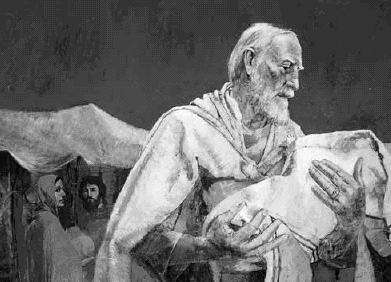
May we all become more like Abraham, the father of faith, who "did not stagger by unbelief at the promise of God, but was empowered by faith, giving glory to God, and being fully persuaded that what [God] has promised, He is also able to do" (Rom. 4:20-21).

Monday, January 12, 2009

Lutheran Quote of the Day: Luther on Making Something Out of Nothing

This was posted by Pastor Kurt Hering on the Wittenberg Trail. I thought it was just wonderful, and I wanted to share it with you guys. I think it fits in well with what I said in my previous post, that we are all πτωχοι τω πνεύματι, beggars in spirit.

Psalm 38:21 "Do not forsake me, O Lord! O my God, be not far from me!"

Luther comments: "'I am lonely, forsaken by all and despised. Do Thou receive me, and do not forsake me.' It is God's nature to make something out of nothing; hence one who is not yet nothing, out of him God cannot make anything. Man,however, makes something else out of that which exists; but this has no value whatever. Therefore God accepts only the forsaken, cures only the sick, gives sight only to the blind, restores life only to the dead, sanctifies only the sinners, gives wisdom only to the unwise. In short, he has mercy only on those who are wretched, and gives grace only to those who are not in grace. Therefore no proud saint, no wise or righteousperson, can become God's material, and God's purpose cannot be fulfilled in him. He remains in his own work and makes fictitious, pretended, false, painted saint of himself, that is, a hypocrite."
-
-Martin Luther, LW 14:163

Friday, January 9, 2009

The Indicative and Imperative Nature of Faith and New Life

This is a section out of my senior thesis on sanctification. What it addresses is the seemingly conflicting scriptural portrayal of rebirth and renewal as being, at one time, solely the work of God, and at another, an imperative placed on man to conform to God's will. It is a matter of resolving indicative and imperative. Various Lutherans have addressed this issue, namely, Paul Althaus, Helmut Thielicke, Adolf Köberle, and to a certain extent, David Scaer. Helmut Thielicke, though, is the one who really hits the nail on the head in the first volume of his Theological Ethics. I have previously written on this topic in my post The Word, Communication, and Sanctification.

We heard a little on this topic from Paul Althaus in the post Althaus on Faith and Command. There are a couple of things in his portrayal that are not quite correct. 1) Althaus talks of: "Insofar as it is God's gift." When talking of indicative and imperative, we cannot say: insofar as it is indicative/ insofar as it is imperative. We have to affirm that it is, at the same time, fully indicative and fully imperative. 2) Another problem with Althaus' portrayal is that he talks of rebirth and renewal (faith and new life) as being, from the standpoint of God, indicative, and from the standpoint of man, imperative. Indicative and imperative is not a matter of perspective, as if man simply acts and thinks as if it were all his work, while in reality it being solely the work and fruit of God. Paul makes it clear that when man acts in autonomy from acknowledgment of his total reliance on God's grace, he acts in rebellion to God. We hear from Paul:

"Work out your own salvation with fear and trembling, for it is God who works in you, both to will and to work for his good pleasure" (Phil. 2:12-13).

"So, then, it is not of the one willing, nor of the one running, but of the One showing mercy, of God" (Rom. 9:16).

God tells us: "My grace is sufficient for you, for My power is perfected in weakness" (2 Cor. 12:9).

When God says "weakness," he does not mean, those who are especially deficient in themselves, rather those who recognize that without Christ, the Vine, they can do nothing (John 15:5). But we, at the same time affirm, "[We] can do all things through him who strengthens [us]" (Phil. 4:13). When we look at the subject of Christ's beatitudes compared to, say, the Pharisees, the difference is not that the Pharisees are stronger, etc., rather, it is the poor in spirit, the mourning, the meek who recognize their total dependence on God's grace, this is why they are called blessed; we are all πτωχοι, literally, beggars in spirit, and yet, in this, we are blessed!

The Lutheran understanding of faith is a perfect example of the indissoluble connection of indicative and imperative. Emil Brunner writes: "The Word of God and the word of faith are inseparable. It is not God who believes but I myself who believe; yet I do not believe of myself, but because of God's speech." (Man in Revolt: A Christian Anthropology, trans. Olive Wyon (Cambridge: Lutterworth Press, 2002), 67.) Faith is at one and the same time completely the work and fruit of the Spirit of God, working through the Word, and yet, it is also my response to God's Word, God's claim on me. Faith is never, whether at the outset, in the midst, or at the end, a fruit of anything that is in me, and yet it is I who believe, it is I who say "yes." The Formula of Concord can even say that we "accept the offered grace." (SD Art. II, Par. 83) This is not inappropriate language if, and only if, the relation of indicative and imperative are understood correctly.

(You are not able to read this from a feed, you must come to the blogspot site.)
The Indicative and Imperative Nature of Sanctification

Friday, December 12, 2008

Law, Gospel, and Eschatology in Gerhard Forde

Gerhard Forde's understanding of law and gospel is partly determined terminologically, partly eschatologically. I've been pouring over what Forde has written and I must admit that much of what he says is highly convoluted and abstract. Many of his distinctions seem arbitrary at best, though, overall, they express many of his broader concerns of how man lives under the gospel and how man lives under the law.

First off, we should address what Forde sees as the content of the will of God. It might be said that Forde didn't see the "content" in a quantitative sense but rather in a qualitative sense. He was wary of seeing the will of God as an eternal set of prescriptions. "At no time, according to Luther, does man possess full knowledge of the divine will, but only a knowledge of the law appropriate to his actual historical situation. This is true both of man in his original state and in his fallen state." (The Law-Gospel Debate (Minneapolis, Minn: Augsburg Publishing House, 1969), 176.) While this may be true for man who is perfectly righteous, I don't feel this is beneficial understanding of the content in this fallen age. As Paul Althaus makes clear, man as he exists in a paradisical state fulfills God's will in an infinite number of ways; but man in his fallen state is continually thinking up, and acting out new ways of blaspheming God's name. The reality of this, it might be said, is the reason for the need of a law that is explicated such as it is in Scripture. Forde writes: "The entire law is summed up in the First Commandment, which demands a qualitative subjection of man to God in faith and love. No quantitative measurable limit can be set for the fulfillment of such a law." (Law-Gospel, 187) As far as this might be true, this does not mean that an explicated law is not still as validly God's eternal divine will as an ethic summed up under the First Commandment. I will go out on a limb here and say that stealing will never be part of God's divine will. Therefore, and this is what to a large extent Article VI of the Formula of Concord is concerned with, man in his fallen state, with his fallen heart and fallen mind, should apply himself to God's Word where he will find the definite shape of God's will for him. Under Forde, this begins to be more subjective.

For Forde, this content of God's will, whatever it may be, is not yet law. God's will only becomes law when it confronts sinful man. This is where terminological considerations come into play. For Forde, "law" may not even need any true content, rather, "Law is anything which frightens and accuses "the conscience." The bolt of lightening, the rustling of a dry leaf on a dark night, the decalogue, the "natural law" of the philosopher, or even (or perhaps most particularly) the preaching of the cross itself-- all or any of these can and do become the voice of the law." (Law-Gospel, 177) The reason for this is that Forde wanted to keep the term "law" with a completely pregnant definition as that which is contrasted with the "gospel." This in itself is not a problem. Althaus makes a fairly convincing case that the New Testament itself engages in making terminological distinctions between "law" and what the law demands, that is, its content. (Paul Althaus, The Divine Command: A New Perspective on Law and Gospel, trans. Franklin Sherman (Philadelphia: Fortress Press, 1966), 3-7.) The problem with Forde is that his desire to keep a purely existential understanding of law is not coupled with an understanding of how God's will has a positive impact on the Christian in the outward expression of God's work of sanctification. To understand this we need to move from terminological to eschatological considerations.

Gerhard Forde places the law-gospel dialectic into an eschatological, before-and-after scheme. Now, this is not incorrect as far as how he defines law. The law, as "that which accuses sinners," is of temporal validity. Paul's existential depiction of the law and gospel is a reflection of this. The problem for Forde comes in in how these "two ages" relate and come about in the lives of believers. This is all closely tied to his understanding of sanctification. Forde liked to see things in wholes: either law or gospel; total judgement or total grace; this age or the next; death or resurrection; indicative or imperative; nothing or all; law (existentially understood) or fulfillment. For Forde things don't come in "parts." Let's hear some examples of this:

"From this point of view the way of the sinner in sanctification, if it is a movement at all, is a movement from nothing to all, from that which one has and is in oneself to that which one has and is in Christ. Such a movement can never be completed this side of the grave. Nor could it be a continuous movement through increasing degrees of approximation. Rather each moment, each encounter with the shock of divine holiness, could only be at once both beginning and end, start and finish." (“Eleventh Locus: The Christian Life,” In Christian Dogmatics, Vol. 2, ed. Carl E. Braaten and Robert W. Jenson, 391-470 (Philadelphia: Fortress Press, 1984), 431.)

"There is no “system” as such which can distinguish between the ages or can provide a continuous transition from this age to the next. Only the death and resurrection of Christ, the act of judgment and grace, is "the way."" (Law-Gospel, 223)

"In the church the believer comes to understand his existence in terms of two ontological determinations of his being, being “in Adam” and being “in Christ.” This corresponds exactly, of course, to the dialectic of the two ages." (Law-Gospel, 225)

"The progress for Luther has in mind is not our movement toward the goal but the goal's movement in on us. Imputed righteousness is eschatological in character; a battle is joined in which the totus iustus moves against the totus peccator." (The Christian Life, 435)

"The decalogue remains eternally in the sense that the reality demanded remains, but not as law. Here the distinction is between reality (res) and law, but not between the essence of law and the office of law. The term “law” applies only to the “office,” and not to the res." (Law-Gospel, 184)

For Forde, it is either law in the old age or fulfillment in Christ in the new age. The problem with this is that this is not reflective of how life actually works. By this, I don't only mean that this is not how we perceive it working but also how it actually works. Forde continually asserted that the new life was a death and resurrection. The problem I see in Forde is in his depiction of how this "reanimation" takes shape.

"Thinking theologically about the dialectic involves the fact that this act is at once total judgment and total grace. The fact that it is total judgment means that there can be no attempts on man's part to translate himself prematurely into the new age either by his action or by his thinking. Man's acting and thinking in this life remain and acting and thinking in this age, under the eschatological limit. The fact that it is also total grace means that man can be content to allow his acting and thinking to remain as it is, totally in this age; he can trust in Christ entirely for the gift of the new age." (Law-Gospel, 223-224)

Forde believes that "the eschatological possibility is made a present possibility only through faith in Christ." (Law-Gospel, 185) Because of this, acting and thinking on the Christian's part is and remains an acting and thinking in this age. This places into question how the Christian plays any role in participating in the new age. And consequently what role the law (understood as to its content) plays in the life of the Christian qua Christian. Forde writes:

"Law cannot be reintroduced after the end, for the end means perfect fulfillment. A perfect lover would not need laws about what to do. A perfect Christian would not need to be told what was right or wrong. One must hold out for that vision lest law conquer all. The day when all will be “written on our hearts” is the center of the biblical promise." (The Christian Life, 449-450)

It should be noted that by "end" Forde does not mean necessarily the end of the age, he means, including this, the new age which comes even "now." If it is the new age then it comes completely; there can be no "partly new age/partly old age." It is for this reason that Forde was so skeptical of any attempt at "redeeming" the law in this age; if we are dealing with it with our thinking and action then we are dealing with it in this age, if it is the new age, it is simply fulfilled. This is reflected in how Forde saw sanctification, as sanctification would obviously be participating in the new age. We read:

"There is no calculation, no wondering about progress, morality or virtue. There is just the doing of it, and then it is completely forgotten. The right hand doesn’t know what the left is doing. Good works in God’s eyes are quite likely to be all those things we have forgotten! True sanctification is God’s secret." (“A Lutheran View of Sanctification.” in Christian Spirituality: Five Views of Sanctification, ed. Donald L. Alexander (Downers Grove, IL: IVP, 1988), 30.)

Any of our own conscious attempts at bringing about sanctification would be a "false eschatology," as Forde would call it. It would be an attempt by our own powers to bring about something that simply happens by grace. Therefore one just preaches law and gospel, bringing death and new life, and we just sit back and "trust in Christ entirely for the gift of the new age." This is not only an incorrect understanding of sanctification but it is also an incorrect understanding of how God's will confronts us. In fact, it completely dissolves any idea that God's will confronts us in the new age because it is either law or reality (res), fulfilled. It is a confusion of indicative and imperative (See my post: The Word, Communication, and Sanctification). By making the new age and sanctification completely indicative, one does not then understand the communicative basis of our existence as being creatures before our Creator. The will of God always stands as an "other." Not that we in a paradisical state will not have the same will as God, rather, God's Word is always something that needs to be conformed to in faith; it is a matter of faith. Paul Althaus writes:

""Command": this implies that another will confronts me, which puts my own will under claim. There is not as yet any opposition between the two, but there clearly is a duality. Unity between God's will and my own is something that has to be realized, over and again; it is not presupposed. The command is a word that stands over me, a word spoken to me. My situation, therefore, is that of one who has to ask, who has to listen, for a word which I myself cannot speak. The fact that God's will confronts us as command is not a condition that arises through sin, or on account of sin; it is an ordinance of the Creator. For God is my Lord. What exists "in the beginning," in the primal state [Urstand], is not a mystical oneness with God, nor an identity of will, but rather a duality: a duality, however, that in every moment is in the process of becoming a unity. But this "becoming a unity" takes place only in obedience. The command does not originate after the fall; it exists already before the fall." (The Divine Command, 9-10)

This does not mean that our existence before God has an ethical basis, but rather it primarily has its basis in faith; it a question of whether or not I will trust God's Word in faith, or whether I will reject that Word. Forde's understanding of the new age, law, and sanctification would never be able to admit this. Forde would not be able see how this could fit into a scheme of salvation as total grace, a total gift. Forde writes:

"It is misleading to say that the command which confronts man is in its basic content nothing other than the gospel. To be sure, if the res to which the law points is realized in the gospel, then there is a sense in which this is true. But when the eschatological framework is missing the statement is misleading. The eschatological dialectic cuts through the underlying Ritschlian moralism." (Law-Gospel, 198)

For Forde it is simply either res, "realized in the gospel," or it is moralism. Kurt Marquart argues against this type of thinking, where sanctification becomes merely an unthinking action, and man becomes an automoton:

"Sometimes we are told that sanctification is best left to itself, that conscious attempts to please God lead to hypocrisy, and that if we just preach the Gospel, sanctification will happen automatically. No, we are not automata. We have a renewed will, which “is not idle in the daily practice of repentance but cooperates in all the works of the Holy Spirit that He accomplishes through us” (Formula of Concord, SD, II,88, p. 561). If being branches in the True Vine (St. Jn. 15) means that like plants we have no conscious intentions, but simply produce fruit “automatically,” then the same applies to the Vine Himself. And that is as absurd as saying that since Christ is the Way and the Door, He is as indifferent as ways and doors are to who is passing over or through them! This pseudo-biblical argument is exactly parallel to that of the old antinomians, who argued that Christians will do the right things “without any teaching, admonition, exhortation, or prodding of the law, . . . just as in and of themselves the sun, the
moon, and all the stars follow unimpeded the regular course God gave them once and for all”
(FC, SD,VI,6, p. 588).

"Clearly the New Testament exhortations to love and good works require conscious effort,
not unthinking, automatic compliance with inner instincts! Thus St. Paul begs the Roman
Christians by the mercies of God (which he had expounded in the preceding 11 chapters) to
present their bodies a living sacrifice, holy, acceptable unto God, as their “reasonable worship”
(Rom. 12:1). And of himself he writes: “Forgetting what is behind and straining toward what is
ahead, I press on toward the goal to win the prize for which God has called me heavenward in
Christ Jesus” (Phil.3:13,14, NIV). No automatism or somnabulism (sleep-walking) here!" ("The Third Use of the Law as Confessed in the Formula of Concord")

Forde recognized that this could be the result of his understanding. We read:

"There is also the danger that speaking of Christ as the “end” of the law (and thus of this age) will become almost exclusively a kind of negative theology, a kind of “negative theology of glory” in which it is difficult to give positive content to the new life in this age." (Law-Gospel, 215)

"But if man's acting and thinking remain acting and thinking in this age, then the problem arises of how the new age takes on any kind of positive reality in this age." (Law-Gospel, 224)

"The greatest danger for the eschatological view that speaks of the death of the old and the resurrection of the new is that the idea of the “new person” can all too easily become a mystical theologoumenon without substance, something the theologian calls on to solve all dogmatic problems. That, no doubt, is what those who insisted on the “third use” of the law were most afraid of: the “reborn” Christian who does not know what to do and is cast on his or her own feelings or autonomy. The new being, however, is to be incarnated in down-to-earth fashion in the concrete calling of the Christian. In that battle—in the calling in this world, in the flesh-- the law of God is ultimately not an enemy or an emasculated guide but a true and loved friend. For one should make no mistake about it: The law of God is to be and will be fulfilled. It will not be fulfilled, however, by our powers, but only by the power of the righteousness of God given in faith." (The Christian Life, 452)

This last quote is about as positive and descriptive as Forde ever gets concerning the shape of the new age. He even uses the term "law"! But the last sentence, "It will not be fulfilled, however, by our powers, but only by the power of the righteousness of God given in faith," and the rest of what Forde has written on this topic leads one to see the new age, the new person, fulfillment, as a mere abstraction, a "mystical theologoumenon without substance."

Monday, November 17, 2008

Lutheran Quote of the Day: Köberle on the Relation of Justification and the Nova Vita

This is a very interesting, if a little simplisitic depiction of the various views of Melanchthon, Luther, Osiander, and Rome between justification and the new life. Adolf Köberle adopts what he believes is Luther's position. Köberle sees the relation between justification and sanctification as paradoxical, as he believes is the position of Luther. While I'm not sure if Luther saw it as such, I certainly don't. Köberle can talk of justification and sanctification as essentially the same act of God though distinguished theologically and by their "inner sequence." I guess I would say that I have a more simplisitc view of their relation. I see them as stemming from the same motivation of God, to restore mankind into a proper relationship with him and with the rest of creation, but not as the same act. I see objective justification as the whole of God's promises to us through Christ, encompasing the whole of salvation history including the Substitutionary Atonement of Christ, the promise of the Holy Spirit's ministry of the Word establishing faith, the promise of sanctification's beginning and consumation upon death, and everlasting life in communion with God and neighbor; that is, Christ's work on the cross brings with it all the promises of the Deus pro nobis, while the individual works-- Atonement, subjective justification, sanctification, etc.--are essentially different.

I just read an excellent article that deals with the very same subject that Köberle talks of here. Though quite a bit longer, I would highly recommend it. It is by R. Scott Clark, entitled: "Iustitia Imputata Christi: Alien or Proper to Luther's Doctrine of Justification?" Clark gives a very thorough examination of the topic, especially of the evolution of Luther's thought, which is so important when trying to establish what Luther's "real" thoughts were. His conclusions are startingly similar to Köberle's.

"All the possible relations of justification and the nova vita came to the fore at least once during the period of the Reformation. Historically they can be designated by the names of Melanchthon, Luther, Osiander and the Council of Trent. What was produced later was partly a deepening, partly a mixture of the previous positions in which unfortunately the most successful solution, that of Luther, was the least considered.

"In the Apology Melanchthon still kept the justum pronuntiari et effici side by side, though the emphasis is already completely on the pardoning judicial decree of God. Following the publication of the Commentary on Romans, 1532, however, the word justification more and more loses its double meaning and at last receives an exclusively forensic character. It is possible to claim that without this sharpened, "disjunctive" form of the sola fide teaching could not have been maintained in the difficult crises of the following centuries. The rejection of every amalgamation not only brought to Melanchthon's theology the advantage of greater systematic clarity but it also really avowed in a unique way the central thought of the Reformation, "Thy loving kindness is better than life (Ps. 63:4). On occasion there are men to whom we must be grateful for having always said only one thing. This gratitude is owing to Melanchthon in the second half of the sixteenth century and to Herman Cramer and his spiritual kindred in the nineteenth century. It is true that both Holl (Rechtfertigungslehre des Protestantismus, pp. 18 seq.) and Hirsch (Die Theologie des A. Osiander, pp. 267 seq.) have pointed out, not without reason, that this separation of justification and renewal in the course of time brought with it questionable consequences. The preservation of the "article of a standing or falling Church" in the school of Melanchthonian orthodoxy cost something, for in time wide circles sought to satisfy their desire for renovation, that was here inadequately presented, in Pietism or Roman Catholic mysticism. Because of its great historic significance, however, Melanchthon's teaching should always be criticised with moderation. As a systematic solution it is certainly not satisfactory.

"With Luther the primary question was likewise not that of making holy but of being accounted holy. The communion with God that has been interrupted by guilt can only be again restored through the removal of guilt (Cf. the Heidelberg disputation of 1518). But besides Anselm and Occam, Luther was also influenced by Augustine and the Mystics who alike (under the influence of Eastern theology) emphatically placed the effective overcoming of the power of sin in the foreground. Besides the idea of the imputation of the righteousness of God we always find associated with it in Luther's ideas the belief in the commencement and continuation of a progressive renewal of life, but with the righteousness of faith ranking above the renewal. For in quite a unique way Luther understood how to distinguish in thought ideas that were for him a real unity; an evidence that he was not so careless in systematizing as men like to picture him. He wanted to distinguish between "external" righteousness and "inner" sanctification but without separating them from each other. His linking together of the two while at the same time maintaining their correct inner sequence will always remain the ideal solution to the problem. So, and only so, will justification be preserved from the danger of quietism and sanctification from the danger of perfectionism. If, on the other hand, the attempt is made to divide the remissio and the regeneratio into two separate acts, occurring at different times, each will waste away with mutual injury.

"A closer examination will further be able to distinguish three periods in Luther's development, each having a different emphasis in the treatment of the constituent parts of this relationship. There is a first period in which he so strongly emphasizes the effici alongside of the reputari that he interchanges them without any scruple and even speaks of a magis et magis justificari. Otto Ritschl (Dogmengeschichte des Protestantismus, II, 1, Chap. 28 seq.) includes the lectures on Romans in this period. Then, however, the emphasis begins to fall ever morre strongly on the Christus pro nobis, which, definitely given the pre-eminence, is combined with the Christus in nobis. Here (say in the commentary on Galatians of 1522-35) is the real climax of Luther's creative activity. In the later part of his life, as a result of his experiences, he approaches closer to the attitude of Melanchthon. The justitia aliena which we already find clearly indicated in the writings of 1520-1521 is more and more placed in contrast to renewal. It is certain, however, that Luther at all times, though with varying degrees of emphasis, held fast to the essential connection of justification and sanctification, while at the same time making clearly the theological difference between the two conceptions.

"What Luther so vigorously welded together was again split apart by Melanchthon as ha gained consideration for a purely imputative view of justification. While the wealth of meaning in dikaioun [justify as forensic aquital] was thus narrowed, through this one-sidedness, the free, pardoning operation of God's grace in behalf of the sinner was given powerful expression. In this way the central thought of the Reformation was not weakened but actually strengthened. Far more serious were the results on the other side, when the emphasis was laid on the effective aspect, when instead of the promise of God the moral change was made most important for the establishment and maintenance of the relationship with God. This was the case with Osiander. He too started with Luther's teaching but instead of stressing the forensic aspect, like Melanchthon, he turned to its effective, immanent aspects. He was strengthened in this position, as E. Hirsch clearly pointed out, through linguistic, philosophical Logos speculations of the Cabalistic and Neoplatonic sort, which he had acquired particularily from Reuchin and Pico della Mirandola. In so far as he made the external word of Scripture the vehicle of the inner justitia essentialis he remained a Lutheran, but when he opposed the teaching of imputation without rightly understanding it, and made the certainty of salvation depend on a progressive qualitas habitualis in animo he became a Thomist. So the certainty based on the forgiveness of sins became a merely subjective assurance that, because it required continual augmentation, was always insufficient. The effects became the cause; the extent of inner experience supplanted the assurance of a divine promise. Infusion took the place of forgiveness; the sanatio that of the imputatio and a quality of the soul supplanted a divine objectivity. Luther too had taught the activity of the one who was justified but for him that was too uncertain and variable a basis to permit faith to be grounded on it; the righteousness that enters into us is only a beginning and therefore only fragmentary. The righteousness, however, that is imputed coram deo is tota et perfecta. Osiander's ethical protest against the academic externalizing of justification was well meant but his view of the essential infusion of the divine nature of Christ alone, as the means of attaining righteousness before God, not only upset a correct christology (perfectus deus, perfectus homo, Athanasian Creed) but it also distorted the reformers' message of free grace into an ethical-rational sphere. A teaching so strongly reminiscent of the gratia infusa of Roman sacramental theology was no weapon for a Church that had just learned by hard conflicts to find vera et firma consolatio in the gratia extra nos posita. (Cf. Hirsch, p. 271 and the Formula of Concord, Sol. Decl. 623, 59 seq.)

"We can perhaps formulate it thus: for grace, Melanchthon says forgivenss; Luther says forgiveness and sanctification [see my post: "Hey! Let's Keep it Forensic in Here!" ]; Osiander, sanctification and forgiveness. The Roman Church for grace, says only sanctification. The use of the word to describe a purely divine act and a valid promise of grace is expressly forbidden. Si quis dixerit, sola fide impium justificare...anathema sit (Trid. sessio VI, can. 9). Justification becomes exclusively a process of justification (transmutatio), the gratia forensis becomes a gratia habitualis, that through sacramental power is poured into the will. If in Osiander's teaching the renovating power of grace that establishes salvation was still bound in its operation to the viva vox dei in His Word, here, under the influence of Greek theology and a conception of God as a substance, that had been drawn from ancient philosophy, the operation was conceived of as something naturally substantial and consequently magical (actio dei physica). The freely promising, personal working of God is here dissolved into an inner dynamic, an operative function. With such a conception of grace it is no longer possible to speak of a real assurance of salvation."

-Adolf Köberle, The Quest for Holiness, trans. John C. Mattes (Minneapolis, Minn: Augsburg Publishing House, 1938), 92-94 (Excursus).

Thursday, October 23, 2008

Lutheran Quote of the Day: Köberle on "Subjective Grace"

I was interested to find out that the terminology,"obective grace" and "subjective grace," has a history (some of which I agree with, some of which I don't). You know...I just make this trash up, lol.

Here is a quote from Adolf Köberle's seminal work, The Quest for Holiness, reaffirming some of the points in my post, "Hey! Lets Keep It Forensic in Here!". Namely, he states that the experience of grace in the reception of faith (subjective justification) is not dependent on the subject's experience but on the objective Word of revelation. Therefore he want's us to affirm that we should not be suspicious of "subjective grace" (though he doesn't use this terminology) as it finds it's basis outside of ourselves in the objective promises of God.

"For the faith that becomes active in apprehension and emotion does not desire to derive its strength from itself. The "experience" of grace does not put itself confidently into God's place, as it were the actual donor and mediator of grace; it does not depend on its own consciousness; it does not come out of some wellspring of inner nature. It is something purely receptive, begotten and animated by the reality of the divine gift that is apprehended by faith. For this reason we cannot offhand reject the idea of an "experience" of faith as something suspicious and unevangelical, so long as the subjective experience we possess does not come out of some "little paradise of our own domain of the soul," but is begotten and mediated through an objective word of revelation that is accepted by faith."

-The Quest for Holiness, trans. John C. Mattes (Minneapolis, Minn: Augsburg Publishing House, 1938), 78.

Sunday, October 12, 2008

"Hey! Let's Keep it Forensic in Here!" Towards an Objective and Subjective Understanding of Grace

I want to talk about how Lutherans understand grace.

I think there is an increasing trend in Lutheranism to talk of the grace of God in increasingly safe terms. And by safe, I mean in purely forensic and objective terms.

The term forensic is a general term. The Latin forensis generally means: "of a forum, place of assembly." It is used in the sense of things "pertaining to legal trials." (Online Etymology Dictionary) As Lutherans we understand it as our trial or standing coram Deo, before God. We say that justification is forensic, meaning that our justification has its basis outside of ourselves. Through the life, death, and resurrection of Christ, our debt is paid and we are decalred righteous in the eyes of God.

We now say: "Well this is all well and good, but what is all this about grace?" In order for me to continue we need to make a distinction between objective justification, subjective justification, and sanctification.

The increasing tendency, to which I am writting against, is to define grace solely as gratia gratum faciens, that is, grace that makes us acceptable before God. We read from the Apology: "And because this faith alone receives the remission of sins, and renders us acceptable to God, and brings the Holy Ghost, it could be more correctly called gratia gratum faciens, grace rendering one pleasing to God, than an effect following, namely, love." (Tappert par. 116) This quote does not mean that faith itself makes us pleasing to God, but rather that this faith (subjective justification) receives the grace that makes us acceptable before God (objective justification/"objective grace").

The how this faith comes and the subsequent sanctification is what I feel is eroding in Lutheran circles. Part of this is because of understanding grace solely as divine favor and the related misunderstanding of how to define grace outside of this conception. It is the difference between the what of the gospel and the how of the gospel.

The what of the gospel we have down pat. We understand the implications of Christ's life, death, and resurrection for the forgiveness of sins. And we are very comfortable declaring this in absolution, the sacrament of the altar, and through baptism. Luckily, in spite of ourselves, these just happen to be the how of the gospel, that is, how God comes to us and ministers to us, creating, sustaining, and enlivening faith.

The how of the gospel, though, is what I feel us Lutherans have been increasingly shying away from. Declaring what God has done is safe enough; Declaring what God is doing is dangerous. What God has done (in Christ) is safely complete in the past, is safely forensic, and stays safely away from all the subjective realities of the life of faith. Talking about what God is doing is dangerous. It means talking about the Word of God and the sacraments working in the lives of believers, about people's hearts, people's faith, the spirit and flesh, the very dangerous Holy Spirit, and the struggles of daily life.

Related to this is the Lutheran understanding of law and gospel. I think more and more we have lost faith that God is the one working through these proclamations. It is as if we were merely trying to convince people that they're sinful, and merely convince them that they're safely and forensically forgiven. No! To preach law and gospel is a divine activity where the Holy Spirit comes to us and literally puts to death and brings forth new life. It is the difference between preaching about Christ and preaching Christ.

The Church is the body that proclaims Christ to the world. We have been promised that these are not just empty words that appeal to the mind. I think we have become more and more rationalistic in how we approach the Word; we forget that we can only receive the things of God through the Spirit of God. To the natural man, the preaching about Christ means nothing, it is foolishness, it is only because of the active and dynamic presense of the Holy Spirit in this Word that makes it mean anything.

We read from Isaiah: "So shall My Word be, which goes out of My mouth; it shall not return to Me void, but it shall accomplish that which I please, and it shall prosper in what I sent it to do!" (55:11)

In response to 1 Cor. 4:7, "And what do you have that you did not receive? And if you received it, why do you boast as if you did not receive?" Augustine writes, as recorded in the Formula of Concord: "I erred in this, that I held that the grace of God consists only in this, that God in the preaching of the truth reveals His will; but that our consenting to the preached Gospel is our own work, and is within our own powers. Likewise, St. Augustine writes further: I erred when I said that it is within our own power to believe the Gospel and to will; but it is God's work to give to them that believe and will the power to effect something." (SD, Art. II, Par. 27)

How often do we approach the Word of God like this? That we think its proclamation is merely the telling of certain truths that we need to convince our congregations of? Augustine tells us that the grace of God is to be found in this: That through the Word of God, God is the one who is active as he gives us a new will and new powers to respond to this Word.

The what of the gospel is perfectly objective, as it should; what a trajedy it would be for this to be obscured. Reading of the lives of the saints, and even about Luther's early experiences is terribly depressing. The fear and anguish that led them to such extents to assure themselves of the graciousness of God, compared to what I know of the promises of God leads to great relief. I can only rejoice in the complete termination of the need for self-justificatory activity. The words, "It is finished," never grow old. I am daily reminded of the complete impossibility of basing my life on myself and not on Christ. This is the pristine message of the righteousness of Christ that, back in the 16th century, changed the world forever. It is the pure gospel. It is objective. It is sure. I base my faith on nothing less.

But this is only half of the story. Oswald Bayer writes:

"Luther says in the same passage of the Large Catechism that "faith and God" belong together. This is to be understood precisely in the sense of the "and" in the formula: the God who justifies and the human who sins (deus iustificans et homo peccator)." (Theology the Lutheran Way, 20)

Once we start addressing the sinful man, the other half of the theological equation, things get hairy. The God who justifies is pristine, pure, perfect, complete, objective; how the God who justifies interacts with the sinful man is dynamic, scary, life-and-death. But, until we start to recognizing who the object of our message is, we will not be addressing them, but speaking past them. We will not be preaching Christ, but about Christ.

This does not mean that we stop being Christocentric, rather, indeed, we begin to show how truley central Christ really is. Being Christocentric is not merely to say: "you are a sinner; Christ forgives." Paul is a great example for us. For Paul, Christ is not merely some concept of the forgiveness of sins, rather, Christ is a vital and dynamic reality that brings forgiveness and new life. We read from Paul:

"But if Christ is in you, the body indeed is dead because of sin, but the Spirit is life because of righteousness. But if the Spirit of the One having raised Jesus from the dead dwells in you, the One having raised the Christ from the dead will also make your mortal bodies live through the indwelling of His Spirit in you." (Rom. 8:10-11)

"I have been crucified with Christ, and I live; yet no longer I, but Christ lives in me. And the life I now live in the flesh, I live by faith toward the Son of God, the One loving me and giving Himself over on my behalf." (Gal. 2:20)

"For to me to live is Christ, and to die is gain." ( Phil. 1:21)

"Therefore, we were buried with Him through baptism into death, that as Christ was raised up from the dead by the glory of the Father, so also we should walk in newness of life." (Rom. 6:4)

"So that, my brothers, you also were made dead to the Law through the body of Christ, for you to become Another's, to the One raised from the dead, so that we may bear fruit to God." (Rom. 7:4)

"For the love of Christ constrains us, having judged this, that if One died for all, then all died; and He died for all, that the living ones may live no more to themselves, but to the One having died for them and having been raised. So as we now know no one according to flesh, but even if we have known Christ according to flesh, yet now we no longer know Him so. So that if anyone is in Christ, he is a new creation; the old things have passed away; behold, all things have become new!" (2 Cor. 5:14-17)

"And He said to me, My grace is sufficient for you, for My power is perfected in weakness. Therefore, I will rather gladly boast in my weaknesses, that the power of Christ may overshadow me. Because of this, I am pleased in weaknesses, in insults, in dire needs, in persecutions, in distresses, for the sake of Christ. For when I may be weak, then I am powerful." (2 Cor. 12:9-10)

We are told that God's grace is sufficient because his power is perfected in weakness. This is the major problem behind the Roman Catholic understanding of grace. Catholics see grace as a gratia infusa, an infused grace. Paul tells us that grace is not something that empowers us, rather, grace comes through our weakness so that the power of Christ overshadows us.

The problem with the common Lutheran understanding of grace is that we have not clearly replaced the Catholic understaning with our own. We have a clear definition of God's grace as his divine favor, that is, an external, forensic, "objective ("existing independent of thought or an observer as part of reality" - Dictionary.com) grace;" but we have not clearly defined how God's grace is shown through his internal work in heart, mind and abilities; "subjective ("pertaining to or characteristic of an individual; personal; individual"- Dictionary.com) grace."

I believe Werner Elert offers a very good distinction that should be adopted as the Lutheran replacement for the error of gratia infusa. We read:

"The change is not effected by the infusion of an object by grace (gratia infusa), but by the personal presence of the Spirit in the Word of grace. Whether this Word is a real force or not can only be answered by those who know they live by grace alone. The righteous shall never perceive it. The poor sinner under sentence of death who has fallen to his knees to be judged hears at this very moment the words, “You are forgiven, rise.” When he finally arises, still shaky and unsteady because his knees seem unable to hold him up, he takes his first steps into the new life which has been granted him a second time. He receives the strength to do it through the perceived Word of grace. No one will ever convince him that his strength was a product of his imagination. The strength to live a new life in grace is the strength of the Holy Spirit." The Christian Ethos, trans. Carl J. Schindler (Philadelphia: Muhlenberg Press, 1957), 217.

That is, a renewed understanding of "subjective grace" in the Lutheran Church is to talk of "the personal presence of the Spirit in the Word of grace."

Though the subject, ourselves, are sinful, fallen, prone to distort, and ego-centric, "subjective grace" in itself is nothing to be wary of. This is because subjective grace does not have the subject as its center, but rather the objective promises in God's Word; it is Christo-centric. It, in a very personal way, deals with and in the subject, but it does not have its basis in the subject; it is not dependent on my own thoughts, feelings, faith, rather, it often works in spite of these things. Bringing back what Paul says 2 Cor. 12, subjective grace puts to death the subject and raises him in the power of Christ; God's grace is perfected in weakness.

The purpose of the pastor is not to lead their parishoners back to themselves (ego-centricism), but to direct them to the promises of God in Word and sacrament (Christo-centricism). As Kurt Marquart says: "It is through these blessed Gospel-channels that the divine life of faith is transmitted to us sinners." "The Third Use of the Law as Confessed in the Formula of Concord." The gospel is not merely a forensic declaration, rather it is also a life-principle that subjectively creates, sustains, and enlivens faith and impels us toward righteousness unto sanctification (Rom. 6:19)

Talk like this as scary for us Lutherans. We cannot point to it, define it clearly, or say it will behave in this way rather than that; "The Spirit breathes where He desires, and you hear His voice; but you do not know from where He comes, and where He goes; so is everyone having been generated from the Spirit." (John 3:8) While all these things are true, we should not fear the Holy Spirit. This is because he is always connected to the promises of God, to his Word, and does not have his basis in the subject.

We have faith in this promise. The Solid Declaration says as much, that we can have faith in the activity of this Word, not based on the subjectivity of self, but on the based on the objectivity of God's promise. We read:

"Therefore, neither the preacher nor the hearer should doubt this grace and activity of the Holy Spirit, but they should be certain that when the Word of God is preached purely and clearly according to God's command and will and people listen to it seriously and diligently and meditate upon it, God will certainly be present with his grace and give, as has been said, what human beings otherwise could neither receive nor take on the basis of their own powers. For the presence, effectiveness, and gift of the Holy Spirit should not and cannot always be assessed ex sensu, as a person feels it in the heart. Instead, because the Holy Spirit's activity is often hidden under the cover of great weakness, we should be certain, on the basis of and according to the promise, that the Word of God, when preached and heard, is a function and work of the Holy Spirit, through which he is certainly present in our hearts and exercises his power there." (SD, Art. II, Par. 55-56)

We need to renew this understanding of subjective grace as "the personal presence of the Spirit in the Word of grace." In neglegence, I fear we have ignored this and have not made clear how the means of grace, through the work of the Holy Spirit, effect our daily lives, strengthening and enlivening faith, keeping us from sin and temptation, and impelling us towards righteousness. May we once again be reminded of these words of the Formulators:

"Moreover, this doctrine points us to the means through which the Holy Spirit wills to begin this conversion and effect it. It also reminds us how these same gifts are retained, strenghtened, and increased, and it admonishes us not to let God's grace have no effect in us, but to exercise ourselves diligently in considering what a grevious sin it is to impede and resist the working of the Holy Spirit." (SD, Art. II, Par. 72)