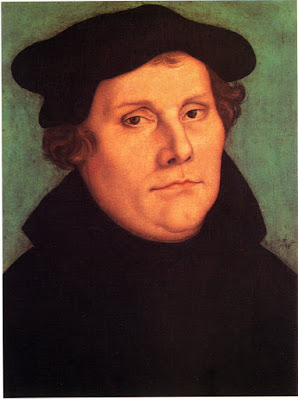


This post is an expansion on some of the arguments I started in my previous post: Witness, Apologetics, and the Law and Gospel. With these posts I want to start painting a picture of how reason and faith should be related within a Lutheran context.
In my previous post I stated that the use of apologetics in a witnessing situation is essentially an aspect of the law. As such it is not a function that creates and builds up faith (the gospel) but rather it brings to task the fallen reasoning of man and his accusations against God on the basis of reason (the law).
In this post I want to address the question: "Why do we really believe?"
As Lutherans we should be wary of the work of many modern Christian philosophers in the area of the justification of belief. Both your evidentialists and your reformed epistemologists have completely discarded the work of the Word and the Holy Spirit in the formation of faith, the result of which is the propagation of Arminian thought and the robbing of comfort to many Christians.
-
-
First off, hopefully with little argumentation, I want to be allowed to disregard the position of reformed epistemology. The foundationalist's argument that belief in God is essentially beyond criticism is absurd. Yes, I am pulling the absurdity card...lets leave it at that.
-
-
But, beyond the absurdity of their argument, reformed epistemology poses many difficulties for those who desire to uphold a Lutheran understanding of man and the reception of faith. Their argument, in some form or another, presupposes that there is an inherent nature in man that is drawn to belief in God or a god, and not only this, faith itself, thus making it "properly basic." This flies in the face of our well established understanding of anthropology. Lutherans believe that there is nothing inherent in man that can be inclined towards belief in God (not to mention the problem of the complete lack of special revelation). The only thing that is "properly basic," to misuse their terminology, for natural man, is sin; no "God shaped hole" (at least from fallen man's perspective). They have completely disregarded the need for the hearing of the gospel (Rom. 10:14) and the essential role of the Holy Spirit in the reception of faith (1 Cor. 12:3).
-
-
Evidentialists, to a lesser or greater degree, would claim that evidence is needed to hold a justified belief. If the evidence is not there, one's belief is irrational, and thus not justified. Under evidentialism one would say that one's reason is able to come upon a justified belief in God. While some may say that the Holy Spirit is also needed, this argumentation is merely semi-pelagian or synergeistic in character. Being that most evidentialist arguments for God's existence come from a natural theology this also does not leave the room for special revelation (specifically Scripture and Jesus' ministry) which is needed for the reception of faith (Rom. 10:14). They also, generally, do not hold that the ministry of the Holy Spirit is evidence on which to base belief. These are positions that are in complete disagreement with the words we confess:
-
-
"I believe that I cannot by my own reason or strength believe in Jesus Christ, my Lord, or come to Him; but the Holy Ghost has called me by the Gospel, enlightened me with His gifts, sanctified and kept me in the true faith; even as He calls, gathers, enlightens, and sanctifies the whole Christian Church on earth, and keeps it with Jesus Christ in the one true faith."
-
-
Here is the distinction that needs to be made: My ability to defend my faith with reason, apologetics, logic, and evidence, is not why I believe.
-
-
Quite literally, I can defend what I believe, but I can't explain to you why I believe it (at least not in a way that would convince you to believe). This is the clear testimony of Scripture: "For the Word of the cross is foolishness to those being lost, but to us being saved, it is the power of God" (1 Cor. 1:18); "For since in the wisdom of God the world by wisdom did not know God, God was pleased through the foolishness of preaching to save the ones believing" (1 Cor. 1:21). It is really an example of the theologia crucis: "We, on the other hand, preach Christ crucified (truly an offense to Jews, and foolishness to Greeks)" (1 Cor 1:23). Paul is not afraid to admit the absurdity of God coming to earth to be placed on a cross. This is because Paul knows the real power behind what he is preaching, that is, the Holy Spirit. It is behind the "Word of the cross," behind the "foolishness of preaching," it is behind preaching "Christ crucified" that the Holy Spirit works in the hearts of men.
-
-
Now, this is not to say that reason, logic, apologetics, etc. are not useful. There is a great need for these things. I will draw on some of my previous points in Witness, Apologetics, and the Law and Gospel.
-
-
These things are needed or useful for the following reasons:
-
-
1) The current state of, especially western, society is one where there are major obstacles to the promotion of the gospel. The hundreds of years worth of using reason, science, psychoanalysis, anthropology, "you name it," to discount the claims of faith are deeply entrenched in our culture and are a major road block for many people to come to faith. As such, reason or apologetics should serve the purpose in tearing down, under the proper functioning of the law (see previous post), the state of the flesh and the work of the devil that prevents the work of the Spirit through the gospel.
-
-
2) Reason, apologetics, etc. can help Christians, not as that on which to base their faith, but rather by fighting against the attacks of Satan and the flesh which cry in our heart: "Is it true that God has said, You shall not eat from any tree of the garden?" (Gen. 3:1).
-
-
As with any function of the law, reason is there to prepare for the work of the gospel.
-
-
But reason, enslaved in this age to the regnum mundi (as Gerhard Ebeling would argue; see previous post), can never be the grounds for why I believe. If reason were pure (that is, without the taint of sin) we might be able to defend belief in God, but this age makes pure reason an impossibility. The arguments hurled against faith, the foolishness of the cross, the flesh that is inclined toward unbelief, and the reality of the lies of Satan leave reason as shaky ground to base one's faith.
-
-
To express the Lutheran teaching on faith correctly, we must be led to say: "Though I can defend what I believe, this is not why I believe." On this is solid ground, in that, our subjectivity is traded for Christ's objectivity. It is through the work of the Holy Spirit working through Word and Sacrament on which I base my faith. It is such words as: "You are forgiven," "Given and shed for you," and the foolish "Word of the cross" that truly contain the "power of God." This is why we (whether we like it or not!) believe.
-P.S. The first to explain the reference in the picture of the Great Pumpkin gets a gold star!!!

