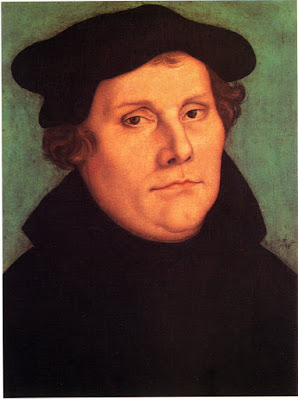
-Wir sein pettler. Hoc est verum.--"We are beggars. This is true."--Martin Luther-

_______________________________________________
[ Home ] [ Originals ] [ Words of Ones Wiser ] [ Odds and Ends ]
Showing posts with label Missions. Show all posts

Wednesday, November 5, 2008

Lutheran Quote of the Day: Köberle on the Work of the Gospel

I really appreciate this quote from Adolf Köberle. I think people who have been in the faith for a long time get complacent in their interaction with the gospel. We need to ever be reminded of the surpassingly wonderful gift of salvation. It is easy to turn justification into a theory, as Oswald Bayer might say. Köberle gives us a reality check here, he makes sure we never forget our "first love" (Rev. 2:4), and reminds us that the gospel of Christ is the "power of God to salvation to everyone believing" (Rom. 1:16). It is always refreshing to observe people who are new to the faith and how different they often approach the gospel compared to the often digressive tendencies of us who grew up in the church.

"Any one who knows but a little of what is being accomplished out on the mission fields through the operation of the Gospel; any one who knows something of the strength of faith and sacrifice that is shown by the baptized heathen who so shortly before were still in fetters, will be inclined to be ashamed of this "European theology" which, as a result of scholastic investigation and almost a century of submersion in materialism seems to have forgotten how to trust in God's greatness or how to ask great things of Him. Here the "paralytic Christianity" (Blumhardt) of the West must turn back and again learn to become like the little children; it must learn from the foolish how the first shall be last and the last first. The thing that impresses every student of missions is the striking parallels he finds to the accounts given by St. Paul of his missionary experiences [see my post: The Power of a Simple Message...]. Here, as there, we find evidence of "actually existing and easily demonstrable operations" of an external power. We see a great break with the heathen past, as for example, in the case of the "great repentance" on the island of Nias in the year 1917. In these fields the fear of demons and the tyranny of sorcery lose their power over enslaved men, as happened once at Ephesus. Shame and repentance, modesty and fervor in prayer appear in hearts before barren and hardened. And all that takes place not as the result of moral compulsion but through the overwhelming conviction of the Spirit working through the Word. In the same way the work of Inner Missions has its Pauline parallels. Here we can see how through the spiritual power of the preaching of the Cross and Resurrection the specific and very real vices of the great cities are overcome, now as then, and how the Easter power of purity becomes manifest."
-
-The Quest for Holiness, trans. John C. Mattes (Minneapolis, Minn: Augsburg Publishing House, 1938), 123-124.

Sunday, October 19, 2008

What Is the Point of Religion?

I meant to write a original post today, but never got around to it. So...I'm stealing a post from Cruising Down the Coast of the High Barbaree called What is the Point of Religion. I'll let the Fearsome Pirate do most of the talking, but I thought there was a strong parallel between this post and what J.P. Koehler talks about. Mainly I mean when Koehler emphasizes that when anything replaces the clear testimony of the gospel and when we recieve our motivations from the flesh rather than the gospel, this unfaillingly leads to death and stagnation in the church.

Here is the post:

The Newman post was not an isolated incident. For the last month or two, I have been thinking fairly continuously about the ruin of religion, more specifically the Christian religion, and what causes it. By "ruin," I don't mean "death." I mean that steep decline from cultural institution to niche, from a church of generations to a church of white heads, from a church of conversion to a church of self-preservation.

My own assesment of the sharp decline of Christianity under Islam is something I've mentioned before and something many people disagree with. When I first learned of it, my first question was, "Why could the martyr church thrive under and eventually topple pagan Rome, but could not under the sultans and caliphs?" Some people argue that the Muslims were simply much more effective persecutors than the Romans. But I saw an active element that was not present in the 1st century--bishops with social and political responsibility and the accumulation of priceless assets and artifacts. Part of the problem, in my opinion, was that the bishops and other key players forgot what the point of this religion is, thinking instead that social order and the protection of shrines and artifacts is the point.

I think whenever you see a church stumble and collapse, you will that some misdirected vision has already broken its knees. The Church is in the business of preaching the Gospel to all nations. There are things that come along for the ride, things that may or may not get connected to that, but those things are not the point. For example, a church may be a haven for immigrants of a certain nation, but if that church starts to believe and act like it exists primarily as a preserver of ethnic identity, it's just a matter of time before a significant collapse. The same goes when a church decides its fundamental business is in high culture, respectable academia, social reform, or glitzy entertainment.

In modern American Lutheranism, many "confessional" Lutherans have made the quest for internal purity, whether doctrinal or liturgical, the chief business of the Church. Judging by the vigorous missional activity of the early LCMS side-by-side with its doctrinal rigor, the early LCMS saw doctrine as serving Gospel proclamation and the making of disciples. But when you get to the 1970s and beyond, doctrinal purity is made an end in itself, breeding a culture of suspicion that is exemplified in orthodox policemen rapidly and aggressively shutting down missional activity whenever they hold the reins of power. And like anyone who has completely lost focus, the claim that the new center of the Church is indeed the Gospel itself. Doctrinal purity is the Gospel. Liturgical rules are the Gospel. The hierarchy is the Gospel. Church growth is the Gospel. Ancient religious culture is the Gospel.

If any of them read the above paragraph, they will tar me as one of those "mission over doctrine" folks. Quite the opposite--doctrine serves mission. But what I see among confessional Lutherans, what I saw at seminary, is more along the lines of "doctrine equals mission," or among folks more enchanted with dress-making, "liturgy equals mission." As a fellow student once sneered, "We have the Divine Service every Sunday. How much more missional can you get?"

The business of the Church is preaching Christ to all nations, teaching his words and commandments, baptizing, and making disciples. You can't cut out the "all nations" and "making disciples," as Lutherans are wont to do. You can't eliminate that part about teaching Christ's words, as liberals and post-Vatican II Catholics tend to do (I am not saying that the teaching of Rome prior to Newman was the same as Christ's--but at least it claimed to be). I think you will find that replacing that basic commission with something else is at the root of the decline of many churches throughout the ages.