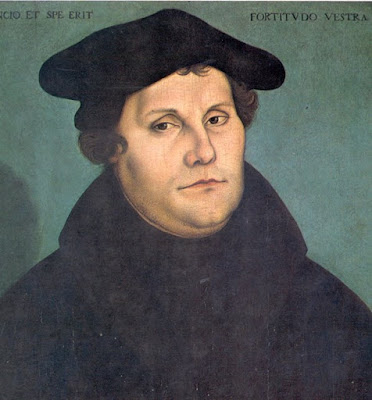
-Wir sein pettler. Hoc est verum.--"We are beggars. This is true."--Martin Luther-

_______________________________________________
[ Home ] [ Originals ] [ Words of Ones Wiser ] [ Odds and Ends ]
Showing posts with label Lutheran Quote of the Day. Show all posts

Wednesday, January 21, 2009

Lutheran Quote of the Day: Bayer on the Performative Nature of God's Word

"Luther also discovers this kind of performative word in the sacraments of Baptism and the Lord's Supper, as well as in the Christmas story ("To you is born this day a Savior!"), the Easter story, and many other biblical passages. As we have said before, he regards these sentences as promises (promissiones). They are the concrete way in which Christ is present, and his presence with us is clear and certain: it clearly liberates us and makes us certain. I cannot remind myself of this freedom and certainty in isolation; I cannot have a monologue with myself. These gifts are given and received only by means of the promise spoken by another person (and not only by the official priest or preacher), who addresses it to me in the name of Jesus. I cannot speak the promise to myself. It must be spoken to me. For only in this way is it true. Only in this way does it give freedom and certainty.

"What this certainty is all about is clear from a short passage in the Lectures on Genesis that Luther virtually offers as a theological legacy: "I have been baptized. I have been absolved. In this faith I will die. No matter what trials and problems confront me, I will not waver in the least. For he who said: 'The one who believes and is baptized will be saved' (Mark 16:16), and 'whatever you loose on earth will be loosed in heaven' (Matt. 16:19), and 'this is my body; this is my blood which is shed for you for the forgiveness of sins' (cf. Matt. 26:26,28), cannot lie or deceive. This is certainly true." In the Lectures on Galatians (1535) Luther writes, "And this is the reason why our theology is certain: it snatches us away from ourselves and places us outside ourselves (nos extra nos), so that we depend not on our own strength, conscience, mind, person, or works but on what is outside ourselves (extra nos), that is, on the promise and truth of God, which cannot deceive.""

-Oswald Bayer, Theology the Lutheran Way, trans. Jeffrey Silcock and Mark Mattes (Grand Rapids, MI: Wm. B. Eerdmans Publishing, 2007), 130.

Monday, January 19, 2009

Lutheran Quote of the Day: Bayer on Faith and the Promises of God

I thought this bit from Oswald Bayer's, Theology the Lutheran Way, went well with my previous post, Faith and the Promises of God. In it Bayer affirms the basic structure of a proper relationship before God, that is, in God's self-giving through the Word of promise and our receiving through the open hands of faith. This is what Bayer calls the vita passiva, the receptive life.

"Everything depends on God's performative word for the enactment of the promise of the forgiveness of sins and the healing of our ingratitude towards our creator. Since this word precedes our faith, our response of faith and prayer can never lead us to understand the divine service as a "self-realization of the church." Even as the response of the church faith remains God's work.

"The standard arguments from ecclesiology and sacramental theology resort to the category of "representation," and speak of the "self-realization of the church" and of the church as the "original sacrament." It is clear from this that the criterion of the particular divine service, which Luther vigorously promoted from the beginning of his Reformation theology, is not at all self-evident. For him, worship has to do with the enactment of the word and faith, of promissio and fides. This is classically formulated in the treatise, The Babylonian Captivity of the Church (1520): "For God does not deal, nor has he ever dealt, with us except through the word of promise. We, in turn, cannot deal with God except through faith in the word of his promise." This asymmetrical correlation between word and faith, where the word always comes first and faith follows the word, is for Luther the criterion of the true divine service. At the end of his life he preached a sermon at the consecration of the castle church in Torgau in 1544. There he gave his famous definition of the divine service that beautifully exemplifies this criterion. He calls on the people to join him in the consecration "in order that the purpose of this new house may be this: that nothing else may happen in it except that our dear Lord himself may speak to us through his holy word and that we respond to him through prayer and praise.""

-Oswald Bayer, Theology the Lutheran Way, trans. Jeffrey Silcock and Mark Mattes (Grand Rapids, MI: Wm. B. Eerdmans Publishing, 2007), 88-89.

Monday, January 12, 2009

Lutheran Quote of the Day: Luther on Making Something Out of Nothing

This was posted by Pastor Kurt Hering on the Wittenberg Trail. I thought it was just wonderful, and I wanted to share it with you guys. I think it fits in well with what I said in my previous post, that we are all πτωχοι τω πνεύματι, beggars in spirit.

Psalm 38:21 "Do not forsake me, O Lord! O my God, be not far from me!"

Luther comments: "'I am lonely, forsaken by all and despised. Do Thou receive me, and do not forsake me.' It is God's nature to make something out of nothing; hence one who is not yet nothing, out of him God cannot make anything. Man,however, makes something else out of that which exists; but this has no value whatever. Therefore God accepts only the forsaken, cures only the sick, gives sight only to the blind, restores life only to the dead, sanctifies only the sinners, gives wisdom only to the unwise. In short, he has mercy only on those who are wretched, and gives grace only to those who are not in grace. Therefore no proud saint, no wise or righteousperson, can become God's material, and God's purpose cannot be fulfilled in him. He remains in his own work and makes fictitious, pretended, false, painted saint of himself, that is, a hypocrite."
-
-Martin Luther, LW 14:163

Wednesday, January 7, 2009

Lutheran Quote of the Day: Forell on Unbelief and Sin

"Man's predicament is that he who was created by the love of God to trust in God lives in unbelief and distrust. Pride in relationship to God is unbelief: we do not even believe that he is God. We live as if there were no God. And yet somehow we know that we are not really alone, that we are not merely whistling in the dark. Somehow we know that we are not really the Atlas that carries the universe. Somehow we know that we are not the masters of our fate or the captains of our soul. God is all about us. In him we live and move and have our being--and yet we do not believe. Theologically speaking, unbelief is the basic sin, the ultimate sin: unbelief in the love of God in the very face of this love; unbelief in death in the very face of death; and unbelief in the judgment of God in the very face of his judgment.

"Man looked at from the point of view of revelation looks far different from the man we discussed philosophically and religiously so far. In the light of revelation, man is incurably ill. His disease is sin, the "sickness unto death." It is a disease which he has contracted voluntarily but which he cannot get rid of voluntarily. It is a disease that affects and corrupts everything he does but above all a disease that separates him from his Creator and condemns him to meaninglessness and hopelessness. The disease creates many outward signs. We could mention the tradition capital vices as examples--pride, envy, anger, covetousness, sloth, gluttony, and lust. But theologically speaking, we must say all these characteristics of the disease are expressions of one basic trouble--the chief sin from which all others descend is unbelief. It is because man does not believe in God that he cannot live a meaningful life. As long as unbelief rule men's hearts the Christian life is impossible. It is unbelief which separates man from God, unbelief which brings him into judgment, unbelief that dooms him for all eternity. Man created in God's image becomes through unbelief a caricature. Created to reveal God's love, he chooses to reveal God's wrath and judgment."
--
-George W. Forell, Ethics of Decision (Philadelphia: Fortress Press, 1955), 78-79.

Sunday, December 28, 2008

Lutheran Quote of the Day: Althaus on Faith and Command

Here are some more statements from Paul Althaus. I will respond to them in my final post on the law. The focus is on the relation of faith and the law.

"In the beginning, in the primal state from which we all derive, is the divine command [Gebot]. It is present as the reverse side of the offer [Augebot] with which the eternal love of God originally encounters man. Love's offer says: God wants to be for me; he wants to be my God. He has created me as man, and this means, for personal fellowship with him--for participation in his life in the partnership of love. Just as he, my God, freely gives himself to me, so he calls me also, in his offer, to free self-giving. Thereby he calls me to be his image. Such is his love.

"God's offer, therefore, is at the same time a summons, an appeal, and a command: namely, that I should let him be what he, in his love, wants to be--my God. The command is grounded wholly in the offer; it is wholly borne by God's gift to us. It is this gift that stands at the beginning: God's wanting to be for us. The offer, not the command, is primary. But precisely because this is an offer made in love--love that seeks me as a person--this offer, this gift, necessarily (with the necessity of God's love) becomes also a summons. God cannot be my God in a saving way unless I let him be my God. Otherwise the nature of the personal relationship, as God himself intends it, would be contradicted. He calls me to trust him above all things. This is offer (promissio) and at the same time summons, commands, and call.

"It might well be asked whether it is advisable, from a theological point of view, to designate this appeal of God which accompanies his gracious offer to man by the word "command"--whether the connotations of this term are sufficiently distinct from those of "law." Emil Brunner speaks in this connection of God's "claim on man," or his "summons": "Man cannot receive the love of God save through being commanded to accept it, and in being claimed by God." Our use of the term "command" corresponds to the usage in I John 3:23, where in faith in the name of Jesus Christ is indicated as the content of "God's commandment." According to John, the gospel of Jesus Christ is at one and the same time a gospel and a commandment. This is to say that faith, although it is won from man by God's love, is nevertheless also man's personal act, in and through which he gives, and must give, God the glory (Rom. 4:20). It is in this respect that faith is obedience (Rom. 1:5, 10:3). The notion of "command," then, corresponds to a basic element in the gospel; and if the term is appropriate here, then it surely appropriate also to describe God's original relationship to man. However, we shall find it useful to substitute the word "appeal" or "summons" for "command" from time to time, in order to indicate all the more clearly the contrast with law, and to remind ourselves of the original meaning of divine command as the reverse side of God's offer.

"Thus the command promises life; it is a commandment eis zoen (Rom. 7:10). It calls me into life with God; that is, into freedom from the world, and into love, which is true life. So the command itself is a memorial of God's love for me.

""Command": this implies that another will confronts me, which puts my own will under claim. There is not as yet any opposition between the two, but there clearly is a duality. Unity between God's will and my own is something that has to be realized, over and again; it is not presupposed. The command is a word that stands over me, a word spoken to me. My situation, therefore, is that of one who has to ask, who has to listen, for a word which I myself cannot speak. The fact that God's will confronts us as command is not a condition that arises through sin, or on account of sin; it is an ordinance of the Creator. For God is my Lord. What exists "in the beginning," in the primal state [Urstand], is not a mystical oneness with God, nor an identity of will, but rather a duality: a duality, however, that in every moment is in the process of becoming a unity. But this "becoming a unity" takes place only in obedience. The command does not originate after the fall; it exists already before the fall." (The Divine Command: A New Perspective on Law and Gospel, trans. Franklin Sherman (Philadelphia: Fortress Press, 1966), 8-10.)

"Man, however--and this is another feature of life under the law--fails to understand this situation. He conceals from himself that character of law as a strange word of God--its negativity, its secondary and prohibitive character, its meaning as a sign and shadow of our own past and continuing sin. He thinks that he can use the law in a positive way. The very law which in its form is an expression of the rejection and loss of salvation, and hence of man's state of hopelessness, is treated by man as if it were a means of salvation. He vainly imagines that through fulfilling the law he can repair his shattered relationship to God, that he can become righteous before God. He treats the law, in Luther's word, as justificatrix, as justifying.

"But this is not only a complete misinterpretation of the situation, as illusion (for no one, given the covetousness of the human heart, has been able, since man's fall from fellowship with God, to fulfill God's law), this very effort is itself further sin against God. Indeed, it is the repetition of the primal sin by which man fell away from God, namely, the effort to live before God by something other than God's own love, the love that precedes all our acting. This constitutes a misinterpretation not only of man's situation as sinner, but also of God's godhood and of man's creaturehood. God is God, and wills to be God--that is, to be solely and absolutely the Creator; the Creator not only of our existence but also of the worth and value that we have before him. Because God is God, the only possibility of man's living before him and having some significance in his sight derives from God's own free, unearned, unmerited favor. It is not only the sinner who is wholly dependent upon grace; the same is true of the righteous man--if there is or could be such. To deny this was and is the sin of the pharisee.

"The effort to recommend oneself to God and put oneself right before him by one's own achievements is blasphemy, as Luther put it plainly. It is an attack on the divine majesty of him who is and wills to be always the Creator, not only of our natural life, but also of our place as children in his house. Human ethics can never play the role of securing or preserving man's position before God. This position is something given to him by God's love; it is not earned, nor can it be earned. And this is true not only at the outset, but always; God's saving grace is always prevenient grace. Ethical righteousness as a pathway to salvation is not only an impassible, but also a forbidden, pathway. For to follow this pathway would be to surrender the relationship of childlike trust. This way can only serve inevitably to confirm again and again man's inevitable sinfulness. From beginning to end, it is an expression of his sin, indeed of the basal sin by which he fell and continually falls away from trusting faith in God's love." (The Divine Command, 16-17)

"Basically, to be sure, the Christian, in faith, is at one with God's loving will and rejoices in it. There is nothing he desires more ardently than that God's good and gracious will should be done in us and through us. But this basic oneness of my will with what God wills must become a matter of concrete experience in an ever new enacting of this oneness. The basic surrender must be expressed in ever new concrete acts of surrender. For the duality remains, the otherness and newness of the concrete will of God in contrast to my human expectations and desires. Again, this becomes plain to us in the figure of Jesus Christ. Even for him who as the Son lived in an unbroken fellowship of love with the Father, "my will" and "thy will" were two different things, as the prayer in Gethsemane reveals. Even though throughout his life he was of one will with the Father, nevertheless in every concrete instance he had to become one with the particular will of the Father, moving to such unity from the duality of "my will" and "thine." The fact that this was so even in Jesus' case demonstrates that this basic duality, this distinction between what we ought to do and what we ought to do and what we wish to do, is not as such to be attributed to, or regarded as an expression of, the sinfulness of our will. Rather it is given in and with the very fact that Creator and creature, Father and son, Lord and servant stand over against one another. Although Jesus "knew no sin," God's will still confronted him as an other--not implying that he was a sinner, but only that he too stood under God as his Lord. God's will is an "other" not only vis-a-vis our sinful desires, but also vis-a-vis our natural desires as creatures. . .This becomes especially clear when God's will calls on us to suffer. It is not the Creator's will that anyone should deliberately wish for suffering and death, weakness and failure. Nevertheless, God may sometime ask this of us, as he did of Jesus. (The Divine Command, 36-37)

In our opinion, this juxtaposition [between indicative and imperative] is an expression of the peculiar character of all human existence before God, and hence also of Christian existence. Paul's words in Philippians reflect this same duality: "Work out your own salvation with fear and trembling, for God is at work in you, both to will and work for his good pleasure" (2:12f.). This means (1) we know that faith, and with it, the new life, remains always God's gift; and yet (2) we know always that we are called and are responsible to have such faith and to walk in this newness of life. Our being Christians is at every moment a gift of God, and likewise in every moment, from our standpoint and with respect to us, a task. Insofar as it is God's gift, we may and must describe our state as Christians as a state of being, which now simply operates and out of the power of God brings forth "fruit." This is a matter of the indicative. But faith and the new life--which from God's standpoint constitutes a state of being--are from the human standpoint only realized in that we are called day by day to act in accordance with the new manner of life i.e., to live in faith and love. Here the imperative element appears. It is not the case that we simply live and act as new creatures; rather, we are constantly called anew into this newness [N.B. This is where I feel Forde's understanding is lacking. Forde seems to see sanctification merely as an indicative process almost distinct from human experience. The duality of wills--God's and my own--, being confronted with God's Word, and the imperative nature of our fellowship with God is what is missing in Forde's understanding. On the other hand, I don't quite think Althaus resolves indicative and imperative satisfactorily either.] What we have the privilege of knowing as a state of being, insofar as t is God's gift, is realized over and again (in accordance with the way God has made us as persons) only as an act required in this moment.

"We may speak of fruits, whose appearing may be taken for granted if we are thinking of the faithfulness of God (I Thess. 5:23 f.; I Cor. 1:8 f.). He has begun a good work in us and will bring it to completion (Phil. 1:6). It is he who makes me fruitful. But this trust in God does not abolish our own responsible character as persons, nor does it negate God's challenge to us, which calls for a response in continually new acts of decision.

"Thus our Christian life stands at all times under the double aspect of being and act, gift and assignment. The "being" is really only in terms of personal "act." But the very act demanded of us, we beg and receive from the faithfulness of God. It is this faithfulness on which the continuity of the new life is based.

"All this is true of faith as well, as we have already indicated. It too bears this double character. God effects faith in me; and yet the New Testament presents also the imperative: "Only believe!" (Mark 5:36; Luke 8:50). "Have faith in God!" (John 14:1). Faith itself is the object of an appeal, an imperative.

"We conclude, therefore, that the relationship between faith and works is not a causal one. Faith in not, from the human perspective, a state of affairs that simply works itself out in such a way as to lead with causal inevitability to the new life as its "fruit." This could not be the case, since I am continually called to have faith, and not to persist in unbelief. Faith itself stands under the same imperative as does action. It exists only in ever-repeated enactment. This enactment, however, takes place in terms of concrete deeds, of works. [Althaus is simply wrong here. Works do not enact faith or make it "concrete." Works may flow from faith and may be the natural outcome of faith, they do not, however, enact faith.] So it is not a relationship of causality that prevails between faith and the new life, but rather a relationship of immanence. As we have already stated, works do not follow from faith; but, rather, faith lives in works, in attitude and action.

"Therefore, if the new life of the Christian is pictured as "fruit," this must not be taken to imply an ethical automatism in the believer. Faith does not lead to action by virtue of a psychic compulsion. Such an interpretation would be a misuse of the image of fruit. This image can only serve to indicate the inherent necessity with which the gospel, as grasped by faith, presses to deeds of love." (The Divine Command, 40-42)

"In his Small Catechism, Luther describes faith as the source of life in obedience to God's commands by beginning the explanation of the first commandment: "We should fear and love God, and as a result. . ." In his Treatise on Good Works and in the Large Catechism he describes how faith does what the commandments say we ought to do and thereby fulfills. He demonstrates that the actions forbidden by individual commandments flow from mistrust of God and unfaith in Christ; similarly, he shows that it is faith that produces the righteous works which they command." (The Ethics of Martin Luther, trans. Robert C. Schultz (Philadelphia: Fortress Press, 1972), 15.)
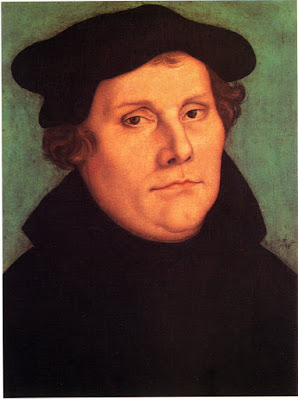
Friday, December 26, 2008

Lutheran Quote of the Day: Malysz on the Incarnation

"God's continued self-giving reached its apex and most perfect manifestation in his offering of himself to man in the most intimate of ways--by becoming man and sharing in the humanity of his children (Heb2:14).

"The incarnation is fundamentally consistent with God's preservation of the whole creation and thus with his very being. It is an extension of his loving presence. What is of significance is that God the Son was "made like his brothers in every way. . .yet was without sin" (Heb 2:17; 4:15). He became a man perfect in his humanity, with the fullness of its God-given relational potential, only to take upon himself our isolation and enslavement. He thus conquered sin by trustingly offering himself both to God and fellow men, even to the point of death. In the midst of life's ambivalence, he exposed with utmost clarity the deceptive nature of sin, based as it is on a fundamental denial of God's nature as love. Thus in Christ, the despairing sinner again perceives the astounding faithfulness and the life-bestowing love of God--not merely for himself but for all of creation."
-
-Piotr Malysz, “Third Use of the Law in Light of Creation and the Fall,” Logia 11, no. 3 (2002), 17.

Thursday, December 18, 2008

Lutheran Quote of the Day: Luther on the Spiritual Government

This is a quote lifted from A Long Walk With Martin Luther. It is a good example of how Luther talked of the spiritual government (regimente).

"Those who believe and whom the Holy Spirit touches through the Word know and receive the Holy Spirit, even though this is not at all apparent to the world. Therefore it is a different word and a far different government from that of a man. Beyond question it is the Word of God that speaks through us and through which He is powerful in the church. He does all things with the Word alone, illumines, buoys up, and saves; for it is a Word of promise, grace, eternal life, and salvation.

"Concerning this efficacy of the Word the world knows nothing. Yet just as in the Gospel Christ casts out demons by means of the Word, so the minister says to the sinner: “I absolve  you from all your sins.” And this is the way it happens. For it is not the word of a man, at whose voice the devil would by no means flee. Even if all the jurists and all the philosophers were to heap up all their books, nothing would happen. But when the minister pronounces absolution, liberation from the devil and from sin is sure to follow. If the Holy Spirit grants you grace to believe, there He drives out Satan and death with one word."

-Martin Luther, LW 8:271

Wednesday, December 17, 2008

Lutheran Quote of the Day: Malysz on the Primal Nature of the Command

"What is significant about Adam is that he alone becomes the locus of God's self-sharing. In Adam God reveals himself as self-giving, as love. Through creation, he who already perfectly and sufficiently affirms otherness within himself--as Father, Son and Holy Spirit-- freely reaches out to another. On other words, man is the only creature willed by God for its own sake. Such is the nature of love. It affirms another not because of a vested interest, but freely and disinterestedly, for the other's sake. It finds the other beautiful and interesting.

"God's love, as it finds beauty and a source of interest in the other, truly creates the other to be beautiful and interesting. Thus, surveying his creative work, God was able to conclude approvingly that "it was very good" (Gn 1:31). The divine self-sharing manifests itself, in the first place, in the act of creation itself. But it goes much further. Man receives God's blessing, as he it told to "be fruitful and increase in number." All that God has created is now entrusted to him to rule over and to subdue (Gn 1:28). What this means is that creation is God's gift to be used in a meaningful and responsible way. Finally, God shares with man his own being. The latter not only has a direct and personal experience of his Creator, but is himself created to reflect the being of God.

"Man is created with a capacity to love and to reciprocate love. Like God he has the ability to go beyond himself. In the same way that God affirms otherness within himself, man, too, is made to affirm another, so that the two "will become one flesh" (Gn 2:24). Further he is endowed with the capacity to affirm creation--it finds its meaning in his responsible and God-like stewardship. As one commentator put it, "while [man] is not divine, his very existence bears witness to the activity of God in the life of the world." In other words, just as God finds Adam and Eve worthwhile and interesting in and of themselves, humans, likewise, are to find God's gift of creation worthwhile in and of itself. Creation is not to be abused. Humans are created to love God, their fellow man, and God’s gift of creation. By definition, they are social and vocational beings, relating to others in such a way as to further their good through God appointed means. In so doing, they surrender their being in all its individualism only to gain it back, in, with and through the being of another. Only by receiving and giving can they realize their humanity. Only thus can they be human beings.

"It has already been indicated that love consists in self-giving. Naturally there can be no love under coercion. Thus with its origin in the divine love, human existence is one of freedom. God did not create automatons but beings that were beautiful, interesting and worthwhile for their own sake—individuals with the capacity, of their own free will, to reflect the love received. A loving relationship by nature implies an option for un-love. Love as self-giving implies the possibility of rejection. It is in this context of what love is that the presence in the garden of the tree of knowledge of good and evil finds its purpose. To Adam and Eve was entrusted all that God had created with the exception of one tree, of which they were expressly forbidden to eat. In negative terms, the tree presents itself as an alternative to God's love; it makes the possibility of choosing un-love, or self-love, a real one. In positive terms, it underscores the free and self-giving character of the divine-human relationship, pointing to the centrality of love in the constitution of man. From man's perspective, it makes love possible. Finally, it points to the fundamental significance of trust as an inseparable aspect of love. Adam and Eve knew their creator intimately in his self-sharing. All they were and all that they had came from him. It would seem there surely was a significant basis for trust. And yet, incomprehensibly but in how familiar a way, they gave credence to the serpent's deceitful promise.

"The fall is often portrayed as a transgression of what seemed to be an otherwise arbitrary command. We have already demonstrated that the command was far from arbitrary. Neither was it meant to stress the importance of divinely established order, as if God's self-giving were a mere show. The command was not there to put man in place and show him who really was in charge. On the contrary, it was there to complete his humanness in its capacity for love and freedom."

-Piotr Malysz, “Third Use of the Law in Light of Creation and the Fall,” Logia 11, no. 3 (2002), 13.

Monday, December 15, 2008

Lutheran Quote of the Day: David Scaer on the Law

This is an extended quote from an older article by David Scaer. I think it expresses well some of my own thoughts on the topic. Namely is the topic of the spirit and the flesh, new man and old man. Forde does not address this issue at all, but this is really how the Christian's interaction with the law is presented in Scripture, especially in Paul (Cf. Rom. 7). The fact that the Christian, at one and the same time, both delights in and hates the law does not mean that man himself is the arbiter of how he reacts to the law. This is what Forde was most concerned about, that is, that man would put himself above the law, and thus dispose of it with either his thinking or actions; it would be a premature translation into the eschaton. An understanding of flesh and spirit, and with this the third use of the law, does not imply that man's positive disposition to the law is something that is determined by something "inside" of man, rather the disposition of the spirit, and the third use is clearly depicted as the work of God. If anything, Paul's depiction of the spirit and the flesh in Romans 7 shows how little he himself had over his interaction with the law, but at the same time, Paul also acknowledges that the Christian is critically engaged in and personally aware of how the Spirit is working himself out in our spirit. With Forde's desire to make it clear that man had no role in translating himself into the new age, he also disposed of man himself and the dynamic and very personal experience of what it means to be a Christian and to be confronted with God's Word. His interpretation of the third use of the law is telling in this regard. Gerhard Forde's most vocal complaint against the third use is the idea that the Christian can somehow use the law in a third way. This, though, is clearly a misunderstanding of the third use of the law. Article VI, of the Formula of Concord makes it clear that it is not man who uses the law in a third way, but rather the Holy Spirit (SD VI, 3; 12). It is the Holy Spirit that leads and instructs and guides. All other mention of teaching and instruction in Article VI is clearly shown as not pertaining to the third use of the law (SD VI, 9; 20; 21; 24. See my post on The Third Use of the Law).

III.

"The Formula, in presenting the Lutheran position on the Third Use of the Law, uses Biblical references which refer to the Scriptures in their totality and not only those passages speaking specifically about the Law. Both Psalm 1 (SD VI, 4) and 2 Timothy 3:15-17 (SD VI, 14) are used to demonstrate the Law's validity in the life of the Christian, though both passages refer to the Scriptures in their totality, not simply to the written Law. Psalm 1 speaks about the man who delights in the Books of Moses and the 2 Timothy 3:15-17 passages speaks about the total inspiration of the Scripture and not just the Gospel. Just as Lutherans see the entire Scripture as inspired, so they see the entire Scriptural message, both Law and Gospel, as applicable to the life of the Christian. The Formula sees in 2 Timothy 3:15-17 a direct Biblical command to apply the Law in the life of the Christian (SD V I, 14). Underlying the concept that the Law is made applicable in the life of the Christian through the Scriptures is the Lutheran understanding that the Scriptures in all its parts, both Law and Gospel, are inspired and that these Scriptures are directed to man in the state of sin. The Scriptures are God's written word, necessitated by the fall into sin and directed to man in this fallen condition. Natural Law, sin, and Scriptural inspiration are related to each other.

"Man by the fall into sin was no longer capable of properly comprehending the Law as it originally was part of creation. He followed after that Law, but he fulfilled its requirements only inadequately at best and in every case the Law became his accuser. As a religiously created being, man is compelled by his inherent religious nature to search after God, but these searches are doomed to failure (Apol. IV, 22-25, 40). God through His mercy sent the prophets and later the apostles to proclaim salvation in Jesus Christ. But before the proclamation of salvation could be made, the Law as first found in nature had to be restated in such a way that man in his perverted state could fully comprehend what God had always been setting forth in the natural Law. Both the prophets and the apostles redirected the Law specifically against man's unregenerate nature. They came first to proclaim the Law as a mirror of man's sins, i.e., its second use. Though God condemns through the Law, His proclamation of the Law through His prophets and apostles belongs to God's overall plan of mercy since man by the Law is properly prepared for the Gospel. The Spirit's inspiration of the prophets and apostles embraces not only the words of the .Gospel but also of the Law. The Formula makes no qualitative difference between the Spirit's origination of the Gospel and that of the Law. Both the Law and the Gospel proceed from the Spirit's inner being. Both are His products.

"The person who claims the direct guidance of the Holy Spirit and rejects the Law as revealed in the prophets and the apostles is, in fact, rejecting the Holy Spirit by rejecting His work. Whoever claims a working of the Spirit for his life apart from the prophets and apostles is a fanatic (SD XII, 30). The Holy Spirit has given both the Law and the Gospel and He is responsible for their inscripturation. The Law is valid in the life of the Christian if for no other reason than that it originates with the Spirit and He has caused it to be written in the Holy Scriptures. There are, of course, other reasons for the Law's validity in the life of the Christian. Nevertheless, the Lutherans saw the Law as part and parcel of the special divine revelation. Those who rejected the Law did not only have a faulty concept of the Law itself but of divine revelation and of the Scriptures themselves. Also connected with the concept of the Third Use of the Law was the Lutheran anthropology, the doctrine of man.

IV.

"The Formula reflected the Lutheran view of man as living under the Law in four different conditions: the original created state of moral innocence, the fallen state of sin, the state of regeneration, and the final state of resurrection. The Law in its third function is directed to man in the state of regeneration. Seeing man in these four different phases is essential for a fuller understanding of the Lutheran view of the Law and particularly its Third Use. The Lutheran view dismisses the idea that the Law undergoes any change as it is the expression of God's immutable will (FC SD VI, 15). The four different situations are accounted for by man's differing relationships to God and thus also to the Law. Man, as he is a sinner. can only envisage the Law with prohibitions and penalties as a negative intrusion into his life. It is difficult for man to imagine the original state of moral innocence in which he found positive direction for his life in the Law. In this original condition he needed neither prophet nor Scripture since man's communion with God's creation was itself participation in God's revelation. In the sinless condition man viewed nature and God's revelation as one entity. No special revelation beyond nature was needed. Man in moral innocence needed no Law as a curb for the gross manifestations of evil or for a reflection of his own sin. He needed no special direction of the Law as nature provided a constant, regular communication of the Law. Only in the fallen state is the original positive function of the Law replaced by negative prohibition. Law, understood originally as a description of man's positive relationships to God, to his fellow men, and to his environment becomes with the entrance of sin a negative description of man's broken relationships to God, his fellow men, and his environment. In the first condition, the indicative was merged with the imperative. The Law served as a description of what man was and what he was to do and what he, indeed, could do. There was no tension between what man did and what man could, must, and should do. Now in the state of sin what man must do and should do is not what he can do and does do. The Law becomes a compelling and restraining force against man's rebellious nature. What man once did naturally he is now forced to do against his will. The unregenerate man hates the performance of the Law with an intensity comparable to the first man's love for its performance. The sinner cannot remain morally neutral to the Law. He performs the Law which he hates and he knows that failure to perform its requirements brings penalties. Where he fulfills the Law, he is goaded by the promise of rewards and threats of its punishments. The Law makes the sinner's life miserable (SD VI, 19).

"When the sinner becomes a Christian, the Law begins to take on a new, different character for him. His new condition as a Christian means a new relationship with God and His Law. The Law in this Third Use is addressed to the sinner who has become a Christian but still remains in part under the control of sin (SD VI, 9). Understanding the Law in this Third Use is predicated on understanding the Lutheran view of the regenerate Christian.

"Essential to Lutheran anthropology is the internal strife within the Christian. He is tom between that part of him which wants to obey God's will and the part that feels more comfortable with the older ways of sin. Though this internal struggle is never over in this life, the promise of victory is assured in the resurrection. Several terms express these two opposing forces within the Christian. The part belonging to God is designated as the inner man, the Spirit's temple, and the regenerated man, the man who has been born again (FC SD VI, 5). The part which resists God is designated as the old Adam, the flesh, and in other Lutheran writings the old man. The Law of God remains one and immutable, but as it approaches the Christian, its positive directions apply to the converted part and its negative prohibitions with the threats of punishments are directed to the unregenerated condition.

"The Christian only so far as he is regenerated is free from the threats and curses of the Law (SD VI, 23) and he recognizes this Law as God's will for his life (SD VI, 12). The Formula uses picturesque language in describing the Christian's response to the Law. In this renewed condition he "does everything from a free and merry spirit" (SD VI, 17). Such good works are motivated by the Holy Spirit and flow from faith, but they are all in accordance with the Law, which is also the Spirit's product (SD VI, 12). Works flow from faith as water comes from a spring, but these works flow down channels established by the Law. This positive direction of the Law without prohibition or fear of punishment is what is essentially meant by the Third Use of the Law.

"Law as a positive direction in the life of the Christian is both a restatement of the original paradisical condition and a preview of the future state of glorification. In Paradise man knew the Law of God perfectly and rejoiced in it. Also in the final state of glorification man will not need or hear the negative aspects of the Law. So even now the regenerate man hears the Law of God, rejoices in it with his inner being, and performs it without thought. of reward. His only motivation is that he wants to please God.

"Law understood in this Third Sense as positive direction and guidance in the life of the Christian presupposes the Gospel. In each of its uses the Law is both didactic and imperative. It is not constructed to change man from a sinner to a saint and cannot effect regeneration. The Spirit's working through the Gospel is the cause of regeneration. But the Gospel presupposes the Law. just as the Law in the life of the Christian presupposes the Gospel. The Gospel is the proclamation that Jesus has fulfilled the Law's demands and suffered its penalties in man's stead. This message alone effects regeneration. The Law is the skeleton on which the life and death of Jesus is sketched out. The skeleton of the Law as it is framed in the Gospel message comes to the sinner having its structures completely filled out by Jesus. The Law's negative demands have been satisfied in Jesus so that its force becomes positive in the life of a person who has faith in Jesus. The Law's unfilled requirements have been fulfilled in Jesus. Christ has divested the Law of its negative requirements and He presents it to Christians as positive direction.

"But the Law which comes as positive direction to the regenerate part of the Christian also comes with its negative prohibition to the Old Adam (FC SD VI, 17, 18, 19). Part of the Christian is never converted. He resists believing that God has fulfilled the Law in Jesus Christ. The old man left unchecked would eventually bring man to final ruin and destruction According to Lutheran theology the unregenerate self must be forced and coerced with threats of the Law. The unregenerate part of a Christian is on the same level as the unconverted who "are driven and coerced into obedience by the threats of the law" (FC SD VI, 19). Not only does he fight against fulfilling God's Law, but when he does finally comply with the divine prohibitions in an external sense he becomes a hypocrite as he thinks he has fulfilled God's requirements and earned for himself salvation (FC SD VI, 21). To keep the unregenerate part of man under control, the Christian pastor must preach the negative aspects of the Law. Such works coerced by the preaching of the Law to unregenerated man, even if he is a Christian, have no validity before God for salvation. But the Christian, so far as he is regenerate, performs works from faith which are acceptable to God. These conform to the Law and God finds these acceptable. Though such works are always imperfect, they are acceptable to God because they me performed from faith which is centered in Christ Jesus and not from threats of the Law (FC SD VI, 23).

"It is the preaching of the Law and not the Gospel which alerts the Christian to the tension within himself. The same Law which is an expression of God's will in the life of the Christian remains a severe condemnation on his unregenerate nature. This tension, a dualism within the Christian, finds its real cause not in the Law but within the Christian himself. The work of the new man committed to Christ is countered by the old man who only gives up the struggle at death. Underlying the Lutheran concept of the old man is the Lutheran doctrine of original sin. The man who is totally unregenerate is brought struggling and kicking to faith. When a new life has been created, he continues to struggle, kick, and fight against God. The old man is not to be handled in a gentle and kindly way and then treated to the good news of salvation, but he is to be forced and threatened by the Law. The Formula puts it strongly (SD VI, 24):
For the Old Adam, like an unmanageable and recalcitrant donkey, is still a part of them and must be coerced into the obedience of Christ, not only with the instruction, admonition, urging and threatening of the law, but frequently also with the club of punishment and miseries, until the flesh of sin is put off entirely and man is completely renewed in the resurrection.
"In this life there is no hope for an end to the conflict. The Christian can revert to hypocrisy by believing that he is by himself fulfilling the Law perfectly or he can abandon the Law and become a libertine. But then he is no Christian. The hope for fulfillment in the Christian is not in this life but in the resurrection. Then he will need the preaching of neither the Law nor the Gospel, for he will be in God's presence. In heaven, the Third Use of the Law will be perfectly realized. There Christians "will do His will spontaneously without coercion, unhindered, perfectly, completely, and with sheer joy, and will rejoice therein forever" (FC SD VI, 25). Even in the final condition, it is not the nature of the Law that has changed but rather that man has become totally regenerated."

- David Scaer, “Formula of Concord Article VI. The Third Use of the Law,” Concordia Theological Quarterly 42, no. 2 (1978), 149-154.

Thursday, December 11, 2008

Lutheran Quote of the Day: Luther on the Kingdom of God

Yes, yes. I realize I haven't posted an original in almost two weeks. I promise, I will post tomorrow. For now, here is another good one from Luther:

"The kingdom of God comes...only through the gospel and faith in God, through which hearts are cleansed, comforted, and pacified. For the Holy Spirit fills a man's heart with love and knowledge of God and unites his spirit with God's Spirit. As a result his mind is changed so that he wills and desires, seeks and loves, whatever God wills."

-Martin Luther, WA 15:725

Wednesday, December 10, 2008

Lutheran Quote of the Day: Luther on the Holy Spirit and the Law

If this isn't the third use of the law, I don't know what is...

"Therefore it happens in the New Testament that while the Word of life, grace, and salvation is proclaimed outside, the Holy Spirit teaches inside at the same time. Therefore Isaiah says (Is. 54:13): “All your sons shall be taught by the Lord.” And in Jeremiah we read: “I will give my laws…And they shall all know Me” (cf. 31:33-34). Hence Christ refers to these two prophets when He says in John 6:45: “It is written in the prophets: ‘they shall be taught by God.’” Likewise in 2 Cor. 3:3: “You are a letter from Christ delivered by us, written, not with ink but with the Spirit of the living God, not on tablets of stone but on tablets of human hearts.” Thus we read in 1 John 14:27 that “His anointing will teach you all,” and in John 14:26 “But the Counselor, the Holy Spirit…will teach you all things.” Accordingly, this is how Scripture must be understood when it says that the laws are written in the minds and in the hearts. For by “mind” and “heart” (for this is how we are speaking now) it means intellect and feeling. For to be in the mind means to be understood; to be in our heart means to be loved. Thus to say that the Law is in the mouth means that it is taught; to say that it is in the ear means that it is heard; to say that it is in the eyes means that it is seen. Therefore it is not enough for the Law to be in the soul and to state objectively that it is there. No, it must be in the soul formally, that is, the Law must be written in the heart out of love for the Law."

-Martin Luther, LW 29:198

Friday, December 5, 2008

Lutheran Quote of the Day: Malysz on Dependence and Independence

In preparing for my next series of posts on the law (It will start with Gerhard Forde, but... be patient; tomorrow would be the soonest), I came across this quote from Piotr Malysz. I don't remember if it figured into my first (literally) post on dependence and independence, but its thesis is strikingly similar. See my previous posts: Dependence and Independence and Self-Generation; Dependence and Independence Cont.. I find the paradox of being dependent on the created order to show superiority over that created order to be intriguing. We all do it (to a certain extent or another) without recognizing the absurdity of it. It reminds me of Jonathan Swift's "Yahoos." As such we fight over, and strive for power (over God's creation), prestige (from God's creation), popularity (from God's creation), love (from God's creation), acknowledgement (from God's creation); we strive to subdue (God's creation), create (from God's creation), bring under control (God's creation); we use our bodies and minds (that are created) to set ourselves apart from the rest of mankind (God's creation). We do this, much like the Yahoos, without realizing that (without God) we are just animals rolling around in the mud.
"Sin is also enslavement to imperium-- control and, if need be, violence-- as a means of preserving one's integrity. Adam and Eve destroyed their relationships not only by fearing a violation of their trust on another's part but also by chronic suspiciousness of another's, that is, God's self-giving. They saw in God's giving an attempt to confine them into reciprocation, thereby exerting control over their independence. Human life has thus become a struggle for control as a means of survival. This, in turn, has brought about the enslavement of man to creation. Man has abandoned his God-appointed role of creation's steward and endeavours to place himself above the created order as God's equal. But as a creature he can only claim equality with and independence from God by violently lording it over creation, not merely because this is the way he now understands God's being, but also because he recognizes his dependence on creation, which is God's work, and thus on God himself. Exploitation of God's things gives an allusion of power. In this way, creation is necessary for man as a means of self-assertion. The continued increase of his control over the created realm, including other human beings, creates the impression of approximating divinity. Put differently, in order to preserve his integrity, man must enslave. He is both enslaved and enslaver. Paradoxically this only deepens human dependence on the now-hostile creation.

"The isolation and enslavement of sin underscore that-- at bottom- it is a debilitating inability to love and trust, which "like spiritual leprosy, has thoroughly and entirely poisoned and corrupted human nature" (FC SD I, 6). As such, sin undermines everything that human nature was created to represent. Instead of allowing oneself to receive another in his self-giving, and thus to gain oneself, the sinner attempts his self-realization by going in the opposite direction, to the inside. Sin, to use Luther's dictum, makes man into a homo incurvitas in se ipsum. This turning in on oneself is the inevitable price of the trust-destructive misinterpretation of God's being, and thus also of failing to acknowledge one's humanity in its relational richness. In other words, the price of the knowledge of good and evil is the recognition of oneself as evil. Man cannot know evil without at the same time seeing it in himself, in his lovelessness and distrust.

"The tree that Adam and Eve were forbidden to eat from was not, contrary to their expectations, a vehicle of secret wisdom. The knowledge originated within man together with the deed, with his choice of un-love, with his rejection of God's self-giving. It came on the heels of man's attempt to be like God, in which the former isolated himself from his Creator and other human beings, abandoning his unique position within the created realm as the recipient of God's love and blessing. It came with man turning in on himself and the resultant collapse of his being. It is now with great difficulty that man preserves his integrity. He can do so only by a violent, self-centered and self-enslaving exercise of supremacy. Therefore, in so doing, he not only knows evil in himself but also actively propagates it.

"Consider the dreadful ambiguity that underlies all human desire to be creative. Ethically speaking, even the best of human works are tainted by vested interests, resentment, or distrust. Moreover from the scientific perspective, man's harnessing of creation's resources exposes his potential for self-destruction and thirst for more power, as much as it shows ingenuity. Finally, much as he may wish to avoid and ignore it, man meets with disintegration throughout his life only to be confronted by it conclusively at the point of death. The all-consuming presence of death reveals that creation without its steward has gone wild-- it dies both from lack of proper care and from the abuses it suffers at the hand of man. It has become the devil's playground. Man himself-- having separated himself from the life-giving love of God-- faces the same destiny as the creation he was so hasty to abandon in pursuit of self-realization. In isolation from God he is dust and to dust he must return (Gn 3:19). In a word, life without love and trust is deadly. It not only kills the isolated and enslaved human being but also spreads death around in spite and because of human attempts to avoid the inevitable. "Whoever tries to keeps his life will lose it" (Lk 17:33)."

-Piotr Malysz, “Third Use of the Law in Light of Creation and the Fall,” Logia 11, no. 3 (2002), 14-15.

Wednesday, December 3, 2008

Lutheran Quote of the Day: Yeago on Luther on Genesis, all in Hütter

This is from a wonderful essay by (the now defected) Reinhard Hütter called, "The Twofold Center of Lutheran Ethics: Christian Freedom and God's Commandments." I thought this would be a good intro into my upcoming section on the different Lutheran positions on the continued relevance and place for the law in the lives of believers. Both what Luther says and what Yeago says in response, I agree with. I would only offer a slight tweak in emphasis: While the interpretation of the tree is a good one, it is not the only "historical form" (as Yeago would say) by which God ordered Adam's life. Adam was put in the garden to "work it" and "keep it" (Gen. 2:15); God "commands" him concerning the tree (2:15); Adam was in charge of the animals (2:19-20); God created Eve to help Adam (and logically thus, Adam helped Eve), and they were to serve each other as man and wife (2:20-25). From all this I would argue that man was created to live in a communion of self-giving; in worshipping God in service and faithfulness, and in serving each other and God's creation. The command concerning the tree does, though, have a type of arbitrariness to it (in the good sense). That is, by not eating from it, Adam does not benefit creation, nor neighbor, nor God (in that we can never "benefit" God). In keeping the commandment concerning the tree, Adam and Eve, rather, give God the only thing we can ever offer him: loving faithfulness to his Word.

"In interpreting Genesis 2, Luther states:

"And so when Adam had been created in such a way that he was, as it were, intoxicated with rejoicing toward God and was delighted also with all the other creatures, there is now created a new tree for the distinguishing of good and evil, so that Adam might have a definite way to express his worship and reverence toward God. After everything had been entrusted to him to make use of it according to his will, whether he wished to do so for necessity or for pleasure, God finally demands from Adam that at this tree of knowledge of good and evil he demonstrate his reverence and obedience toward God and that he maintain this practice, as it were, of worshipping God by not eating anything from it. [From LW 1:9]

"David Yeago rightly draws the following consequence:

"The commandment is not given to Adam that he might become a lover of God by keeping it; Adam already is a lover of God, "drunk with joy towards God," by virtue of his creation in the image of God, by the grace of original righteousness. The commandment is given, rather, in order to allow Adam's love for God to take form in a historically concrete way of life. Through the commandment, Adam's joy takes form in history as cultus Dei, the concrete social practice of worship... The importance of this cannot be overstated, particularly in view of conventional Lutheran assumptions: here Luther is describing a function of divine law, divine commandment, which is neither correlative with sin nor antithetical to grace; indeed, it presupposes the presence of grace and not sin. This function of divine commandment is, moreover, its original and proper function. The fundamental significance of the law is thus neither to enable human beings to attain righteousness nor to accuse their sin, but to give concrete, historical form to the "divine life" of the human creature deified by grace... The commandment is given originally to a subject deified by the grace of original righteousness, a subject living as the image of God; it calls for specific behaviors as the concrete historical realization of the spiritual life of the deified, God-drunken human being. What happens after sin comes on the scene is simply that this subject presupposed by the commandment is no longer there,; the commandment no longer finds an Adam living an "entirely divine life," "drunk with joy towards God," but rather an Adam who has withdrawn from God who believes the devil's lies about God and therefore flees and avoids God. It is precisely the anomaly of this situation that causes the commandment to become, in Luther's terms, "a different law" (alia lex). [David Yeago, "Martin Luther on Grace, Law, and Moral Life: Prolegomena to an Ecumenical Discussion of Veritas Splendor," in The Thomist, 62 (1998), 176-178.]"
-
-Reinhard Hütter, "The Twofold Center of Lutheran Ethics: Christian Freedom and God's Commandments," In The Promise of Lutheran Ethics, ed. Karen L. Bloomquist and John R. Stumme, 31-54 (Minneapolis, Minn: Fortress Press, 1998), 42-43.

Wednesday, November 26, 2008

Lutheran Quote of the Day: Marty on Legalism

Here is a great quote from Martin E. Marty. I think it addresses some of my own concerns with the current approach in the LC-MS on ethics, specifically in the fields of the two kingdoms and the two kinds of righteousness. Civil righteousness and God's temporal rule through the law is so concrete, and God's temporal rule through the gospel is so undefinable (as much so as the Holy Spirit), that it seems there would be little question as to which we would pick. Especially in a congregational setting, God's rule through the gospel seems a mere abstraction, while simply putting forth and preaching dedication of service to one's neighbor seems to produce the desired results. The natural draw towards a puritanistic work ethic is very appealing not only to the pastor but also to the flesh.

"Legalism is so direct, so problem-solving, so efficient, and has so many accidental but easy ties with Scriptural moments that it seems attractive and agreeable to Lutheran ethics. "Freedom" then relates only to an inner, spiritual reality. "Ethics" is then based on a reintroduction of the Law on all outer, temporal activities. But if legalism is valid in certain areas of life, does it not crowd out freedom in such areas? In that case, is the Christian still not "under the Law" from which Christ on His cross freed him?"

-Martin E. Marty, “Luther on Ethics: Man Free and Slave,” In Accents in Luther’s Theology, ed. Heino O. Kadai, 199-229 (Saint Louis: Concordia Publishing House, 1967), 207.

Friday, November 21, 2008

Lutheran Quote of the Day: "Every Action of the Triune God is a Promise that Gives and a Gift that Promises"

"In the particular divine service, we can hear, taste, and see, through the word, that what holds the world together in its inmost essence is the categorical gift rather than the categorical imperative (contra Kant). The particular divine service does not cultivate its own separate religious sphere, but it discloses the world as creation. In the light of his Reformation discovery that the Words of Institution spoken over the Lord's Supper are fundamentally performative words that give what they say, Luther developed his characteristic understanding of creation as God's gift. Luther has these gift-giving words of the Lord's Supper in his ears, before his eyes, and in his heart when he confesses that every action of the triune God is a promise that gives and a gift that promises.

"The universal character of the categorical gift finds its counterpart in the universality of the response, for which we are empowered by the gift and promise: "For all of this I am bound to thank and praise, serve and obey him." An ethos of giving and love is included in the response. It is included but not identical to it. Thus, it is a mistake to conclude from Romans 12:1-2 that "the doctrines of worship and Christian 'ethics' coincide." It is even less possible to understand this Magna Carta of the new obedience (Rom. 12:1f.) in the sense of the Roman Catholic idea of the sacrifice of the faithful together with Christ in the Eucharist. This proposal is no better than the claim that worship coincides with ethics. Neither proposal has any place for the indispensable distinction between faith as God's service to us, and love as the service of the faithful to their fellow creatures. This distinction is so necessary for salvation that we cannot do without it.

"In the overall context of the letter, the "sacrifice" and the "worship" that Paul speaks of in Romans 12:1-2 explain the significance of Baptism, which Paul sums up as living a new life (Rom. 6:4). This not only has ethical implications but it goes beyond ethics and includes the whole physical perception of the world which needs to be worked out in a comprehensive aesthetics that looks at how our senses, emotions, memory, and imagination are all involved in our experience of reality. We can only view creation properly through that judgment and "death" which is enacted in Baptism; otherwise all talk about creation is idle chatter."

-Oswald Bayer, Theology the Lutheran Way, trans. Jeffrey Silcock and Mark Mattes (Grand Rapids, MI: Wm. B. Eerdmans Publishing, 2007), 86-87.

Monday, November 17, 2008

Lutheran Quote of the Day: Köberle on the Relation of Justification and the Nova Vita

This is a very interesting, if a little simplisitic depiction of the various views of Melanchthon, Luther, Osiander, and Rome between justification and the new life. Adolf Köberle adopts what he believes is Luther's position. Köberle sees the relation between justification and sanctification as paradoxical, as he believes is the position of Luther. While I'm not sure if Luther saw it as such, I certainly don't. Köberle can talk of justification and sanctification as essentially the same act of God though distinguished theologically and by their "inner sequence." I guess I would say that I have a more simplisitc view of their relation. I see them as stemming from the same motivation of God, to restore mankind into a proper relationship with him and with the rest of creation, but not as the same act. I see objective justification as the whole of God's promises to us through Christ, encompasing the whole of salvation history including the Substitutionary Atonement of Christ, the promise of the Holy Spirit's ministry of the Word establishing faith, the promise of sanctification's beginning and consumation upon death, and everlasting life in communion with God and neighbor; that is, Christ's work on the cross brings with it all the promises of the Deus pro nobis, while the individual works-- Atonement, subjective justification, sanctification, etc.--are essentially different.

I just read an excellent article that deals with the very same subject that Köberle talks of here. Though quite a bit longer, I would highly recommend it. It is by R. Scott Clark, entitled: "Iustitia Imputata Christi: Alien or Proper to Luther's Doctrine of Justification?" Clark gives a very thorough examination of the topic, especially of the evolution of Luther's thought, which is so important when trying to establish what Luther's "real" thoughts were. His conclusions are startingly similar to Köberle's.

"All the possible relations of justification and the nova vita came to the fore at least once during the period of the Reformation. Historically they can be designated by the names of Melanchthon, Luther, Osiander and the Council of Trent. What was produced later was partly a deepening, partly a mixture of the previous positions in which unfortunately the most successful solution, that of Luther, was the least considered.

"In the Apology Melanchthon still kept the justum pronuntiari et effici side by side, though the emphasis is already completely on the pardoning judicial decree of God. Following the publication of the Commentary on Romans, 1532, however, the word justification more and more loses its double meaning and at last receives an exclusively forensic character. It is possible to claim that without this sharpened, "disjunctive" form of the sola fide teaching could not have been maintained in the difficult crises of the following centuries. The rejection of every amalgamation not only brought to Melanchthon's theology the advantage of greater systematic clarity but it also really avowed in a unique way the central thought of the Reformation, "Thy loving kindness is better than life (Ps. 63:4). On occasion there are men to whom we must be grateful for having always said only one thing. This gratitude is owing to Melanchthon in the second half of the sixteenth century and to Herman Cramer and his spiritual kindred in the nineteenth century. It is true that both Holl (Rechtfertigungslehre des Protestantismus, pp. 18 seq.) and Hirsch (Die Theologie des A. Osiander, pp. 267 seq.) have pointed out, not without reason, that this separation of justification and renewal in the course of time brought with it questionable consequences. The preservation of the "article of a standing or falling Church" in the school of Melanchthonian orthodoxy cost something, for in time wide circles sought to satisfy their desire for renovation, that was here inadequately presented, in Pietism or Roman Catholic mysticism. Because of its great historic significance, however, Melanchthon's teaching should always be criticised with moderation. As a systematic solution it is certainly not satisfactory.

"With Luther the primary question was likewise not that of making holy but of being accounted holy. The communion with God that has been interrupted by guilt can only be again restored through the removal of guilt (Cf. the Heidelberg disputation of 1518). But besides Anselm and Occam, Luther was also influenced by Augustine and the Mystics who alike (under the influence of Eastern theology) emphatically placed the effective overcoming of the power of sin in the foreground. Besides the idea of the imputation of the righteousness of God we always find associated with it in Luther's ideas the belief in the commencement and continuation of a progressive renewal of life, but with the righteousness of faith ranking above the renewal. For in quite a unique way Luther understood how to distinguish in thought ideas that were for him a real unity; an evidence that he was not so careless in systematizing as men like to picture him. He wanted to distinguish between "external" righteousness and "inner" sanctification but without separating them from each other. His linking together of the two while at the same time maintaining their correct inner sequence will always remain the ideal solution to the problem. So, and only so, will justification be preserved from the danger of quietism and sanctification from the danger of perfectionism. If, on the other hand, the attempt is made to divide the remissio and the regeneratio into two separate acts, occurring at different times, each will waste away with mutual injury.

"A closer examination will further be able to distinguish three periods in Luther's development, each having a different emphasis in the treatment of the constituent parts of this relationship. There is a first period in which he so strongly emphasizes the effici alongside of the reputari that he interchanges them without any scruple and even speaks of a magis et magis justificari. Otto Ritschl (Dogmengeschichte des Protestantismus, II, 1, Chap. 28 seq.) includes the lectures on Romans in this period. Then, however, the emphasis begins to fall ever morre strongly on the Christus pro nobis, which, definitely given the pre-eminence, is combined with the Christus in nobis. Here (say in the commentary on Galatians of 1522-35) is the real climax of Luther's creative activity. In the later part of his life, as a result of his experiences, he approaches closer to the attitude of Melanchthon. The justitia aliena which we already find clearly indicated in the writings of 1520-1521 is more and more placed in contrast to renewal. It is certain, however, that Luther at all times, though with varying degrees of emphasis, held fast to the essential connection of justification and sanctification, while at the same time making clearly the theological difference between the two conceptions.

"What Luther so vigorously welded together was again split apart by Melanchthon as ha gained consideration for a purely imputative view of justification. While the wealth of meaning in dikaioun [justify as forensic aquital] was thus narrowed, through this one-sidedness, the free, pardoning operation of God's grace in behalf of the sinner was given powerful expression. In this way the central thought of the Reformation was not weakened but actually strengthened. Far more serious were the results on the other side, when the emphasis was laid on the effective aspect, when instead of the promise of God the moral change was made most important for the establishment and maintenance of the relationship with God. This was the case with Osiander. He too started with Luther's teaching but instead of stressing the forensic aspect, like Melanchthon, he turned to its effective, immanent aspects. He was strengthened in this position, as E. Hirsch clearly pointed out, through linguistic, philosophical Logos speculations of the Cabalistic and Neoplatonic sort, which he had acquired particularily from Reuchin and Pico della Mirandola. In so far as he made the external word of Scripture the vehicle of the inner justitia essentialis he remained a Lutheran, but when he opposed the teaching of imputation without rightly understanding it, and made the certainty of salvation depend on a progressive qualitas habitualis in animo he became a Thomist. So the certainty based on the forgiveness of sins became a merely subjective assurance that, because it required continual augmentation, was always insufficient. The effects became the cause; the extent of inner experience supplanted the assurance of a divine promise. Infusion took the place of forgiveness; the sanatio that of the imputatio and a quality of the soul supplanted a divine objectivity. Luther too had taught the activity of the one who was justified but for him that was too uncertain and variable a basis to permit faith to be grounded on it; the righteousness that enters into us is only a beginning and therefore only fragmentary. The righteousness, however, that is imputed coram deo is tota et perfecta. Osiander's ethical protest against the academic externalizing of justification was well meant but his view of the essential infusion of the divine nature of Christ alone, as the means of attaining righteousness before God, not only upset a correct christology (perfectus deus, perfectus homo, Athanasian Creed) but it also distorted the reformers' message of free grace into an ethical-rational sphere. A teaching so strongly reminiscent of the gratia infusa of Roman sacramental theology was no weapon for a Church that had just learned by hard conflicts to find vera et firma consolatio in the gratia extra nos posita. (Cf. Hirsch, p. 271 and the Formula of Concord, Sol. Decl. 623, 59 seq.)

"We can perhaps formulate it thus: for grace, Melanchthon says forgivenss; Luther says forgiveness and sanctification [see my post: "Hey! Let's Keep it Forensic in Here!" ]; Osiander, sanctification and forgiveness. The Roman Church for grace, says only sanctification. The use of the word to describe a purely divine act and a valid promise of grace is expressly forbidden. Si quis dixerit, sola fide impium justificare...anathema sit (Trid. sessio VI, can. 9). Justification becomes exclusively a process of justification (transmutatio), the gratia forensis becomes a gratia habitualis, that through sacramental power is poured into the will. If in Osiander's teaching the renovating power of grace that establishes salvation was still bound in its operation to the viva vox dei in His Word, here, under the influence of Greek theology and a conception of God as a substance, that had been drawn from ancient philosophy, the operation was conceived of as something naturally substantial and consequently magical (actio dei physica). The freely promising, personal working of God is here dissolved into an inner dynamic, an operative function. With such a conception of grace it is no longer possible to speak of a real assurance of salvation."

-Adolf Köberle, The Quest for Holiness, trans. John C. Mattes (Minneapolis, Minn: Augsburg Publishing House, 1938), 92-94 (Excursus).

Thursday, November 13, 2008

Lutheran Quote of the Day: Luther on Promises and Exhortations

"The New Testament properly consists of promises and exhortations, just as the Old Testament properly consists of laws and threats. For in New Testament the gospel is preached, which is nothing else but a message in which the Spirit and grace are offered with a view to the remission of sins, which has been obtained for us by Christ crucified.

"Then follow exhortations, in order to stir up those who are already justified and have obtained mercy, so that they may be active in the fruits of the freely given righteousness and of the Spirit, and may exercise love by good works and bravely bear the cross and other tribulations of the world. This is the sum of the whole New Testament."

-Martin Luther LW 27:47

Monday, November 10, 2008

Lutheran Quote of the Day: Luther on the Power of the Gospel

"Here we…see the power of this preaching of the Gospel. Beyond all the might and power of the world and of all creatures, Christ proves His ability to draw the hearts of men to Himself through the Word alone and to bring them to His obedience without any compulsion or external force at all. Apart from Christ, all men are everlastingly subjects and captives in the power of the devil, of sin, and of death; but He rescues them for an eternal, divine freedom, righteousness, and life. This great and marvelous thing is accomplished entirely through the office of preaching the Gospel. Viewed superficially, this looks like a trifling thing, without any power, like any ordinary man’s speech and word. But when such preaching is heard, His invisible, divine power is at work in the hearts of men through the Holy Spirit. Therefore St. Paul calls the Gospel “a power of God for salvation to everyone who has faith” (Rom. 1:16)."

-Martin Luther, LW 13:291

Sunday, November 9, 2008

Lutheran Quote of the Day: Bayer on the Communicative Basis of Life

I was going to post an original today, but it has evaded me... So here is a wonderful quote from Oswald Bayer. It reflects many of the things I have written concerning the structure of our lives being communicative in nature. I express this explicitly in my post, The Word, Communication, and Sanctification.

Bayer says that the church (in its broadest sense) is the primary order of creation where we are addressed by God's Word and where we are expected to respond to that Word in faith. Life takes on a liturgical shape that is reflected in our own divine service.

"According to the second narrative of creation, God's first word to humankind is the promise of life (Gen. 2:16): "You may eat..."! This promise of life, however, is guarded by a threat of death (Gen. 2:17): "But of the tree of the knowledge of good and evil you shall not eat, for in the day that you eat of it you shall die.

"In his Lectures on Genesis (1535), Luther comments on this passage in lapidary fashion: "Here we have the establishment of the church before there was any economic or political order." Prior to household and government, God instituted the church, not a particular church but a universal church, a church without walls. It existed in the word and in faith, by the fact that God calls Adam (and so all humankind), into life, and in this way "preaches" to him, "sets his word before him." Accordingly, "God wants only this: that he [Adam] praises God, that he thanks him, and that he rejoices in the Lord."

"There are three basic forms of life, three orders (stande). Although they are interconnected, they also need to be distinguished. God the creator has established these orders and he orders human life in them by his word. Of these three basic forms of life: the church, the household (including marriage and family), and the state, the church is the first. It is the basic order. It includes all people, since all are addressed by God and are called to offer him a free and thankful response. We are humans precisely because God has given us life, because he has addressed us, because we can hear him, and because we can and must respond to him. God's address and our human response are the essence of worship. Indeed, they are the essence of religion, cult, and church, if we understand church here as an order of creation. All people and all religions belong to it. Every human being as such belongs to the church, as an order of creation. In fact, this is what defines us as humans. But this order is now corrupt due to human ingratitude and sin, so that it is no longer in fact the church.

"Luther holds that divine service, the church, is meant to be an "order of creation," and not, in the first place, something specifically Christian. That may at first strike us as a strange thesis! But its value will become evident as we proceed.

"The scriptures provide us with the basis for a particular kind of "natural" theology and at the same time a phenomenology of religion. We find it in the primordial promise of life, valid for all people (Gen 2:16), as well as in God's self-introduction, "I an the Lord, your God!" (Exod. 20:2). We also find it in the first commandment, that we should have no gods besides him (Exod. 20:3), where the threat of death guards the promise of life (Gen 2:17). Like Romans 1:18-3:20, natural theology assumes that every human being lives in a relationship with God, which, in practice, is always being broken from our side, and so is fundamentally disordered. Reason, not so much theoretical but practical reason, guided by the imagination, always tries to grasp hold of God, but it is always wide of the mark. Luther (commenting on Jonah 1:5: "The sailors were afraid and each cried to his god") could say quite emphatically: "these men in the ship all know of God" "but they have no sure God." The office of Christ is to make us certain of God."

-Oswald Bayer, Theology the Lutheran Way, trans. Jeffrey Silcock and Mark Mattes (Grand Rapids, MI: Wm. B. Eerdmans Publishing, 2007), 86-87.

Friday, November 7, 2008

Lutheran Quote of the Day: Bayer on the Separation of Faith and Theology

The disturbing decline of any theological integrity, especially among laity, in the church can be directly tied to the modern belief that faith is a purely personal and subjective experience. Bayer argues that this is due to a separation between the concepts of faith and theology. This can especially be seen in American Evangelicalism, though the Lutheran church is certainly not immune to this trend. Recent studies show that even many in the Lutheran church are willing to believe such things as Christ not being the only way to salvation, or salvation occurring outside of the Christian faith. The fact is, everyone has a theology, a set of beliefs that inform the way they view religion, their faith, and their interaction with the Word of God. The problem is, most people believe this is a personal journey that the church has little to do with. The Christian faith, though, is not a road that needs to be traveled alone, nor is it a road that hasn't been traversed before; many have gone before us and have experienced many of the same things we have. It is the Church's job to give their churches the tools to grow and strengthen faith and belief. This starts of course with Scripture, and then with the historic creeds of the faith, and then the historic teachings of their church and their confessions. By not emphasizing these through catechises we deprive our churches of the tools needed to sustain a faith that is based on God's Word. Liturgical churches tend to do this better, it seems, but we all need to decry the claim that one's faith is one's own personal business that one needs to figure out for one's self. While American Evangelicalism has enjoyed great success over the past few decades, this certainly will not last if they continue down the road of their substance-less theology; their congregations will drift farther and farther away from the historic Christian faith, even if their clergy nominally remain to cling to it.

"The point of the meta-critique is to deal with the much-criticized separation of church spirituality from university theology, life from doctrine, and a theologian's personal faith from the issues that impinge on that faith for which the theologian is publicly responsible. However, the meta-critique we are promoting does more than deal with the symptoms of these separations. It attempts to bring about a radical healing by going to the root of the problem. The experience of more than two hundred years of church history, the history of theology, and the history of ideas shows that Semler set theology on a fundamentally wrong course when he made the separations. It is time therefore to take a fresh look at the concept of theology, both historically and systematically... This new look at the understanding of theology within the context of a meta-critical engagement with the classical problems of modernity will shed new light on Luther's understanding of theology. It will also illuminate the traditions of the Middle Ages and of the ancient church, and at the same time Judaism, insofar as these have a bearing on the heart of Luther's theology: the crucial importance of prayer (oratio), meditation (meditatio), and spiritual attack (tentatio) in the formation of the theologian.

"If we affirm Luther's understanding of theology in the context of a critical engagement with the problems of modernity, we will not try to resolve one-sidedly the tension between faith and knowledge, spirituality and scholarship, the affects (which include the emotions, the senses, the imagination, the memory, and the desires) and the intellect, the heart, and the head. In short, we will not try to resolve the tension between its monastic and scholastic aspects. Rather, we must preserve this tension and focus on meditation, which for Luther always means engaging with the biblical text, for this is central to understanding theology as a "grammar of the language of the Holy Scriptures." This is the only way to overcome the modern attempt to treat theology as if it had no substantive object, without resorting to the kind of scientific objectivity advocated by positivism."

-Oswald Bayer, Theology the Lutheran Way, trans. Jeffrey Silcock and Mark Mattes (Grand Rapids, MI: Wm. B. Eerdmans Publishing, 2007), 84-85.