I think there is an increasing trend in Lutheranism to talk of the grace of God in increasingly safe terms. And by safe, I mean in purely forensic and objective terms.
The term forensic is a general term. The Latin forensis generally means: "of a forum, place of assembly." It is used in the sense of things "pertaining to legal trials." (Online Etymology Dictionary) As Lutherans we understand it as our trial or standing coram Deo, before God. We say that justification is forensic, meaning that our justification has its basis outside of ourselves. Through the life, death, and resurrection of Christ, our debt is paid and we are decalred righteous in the eyes of God.
We now say: "Well this is all well and good, but what is all this about grace?" In order for me to continue we need to make a distinction between objective justification, subjective justification, and sanctification.
The increasing tendency, to which I am writting against, is to define grace solely as gratia gratum faciens, that is, grace that makes us acceptable before God. We read from the Apology: "And because this faith alone receives the remission of sins, and renders us acceptable to God, and brings the Holy Ghost, it could be more correctly called gratia gratum faciens, grace rendering one pleasing to God, than an effect following, namely, love." (Tappert par. 116) This quote does not mean that faith itself makes us pleasing to God, but rather that this faith (subjective justification) receives the grace that makes us acceptable before God (objective justification/"objective grace").
The how this faith comes and the subsequent sanctification is what I feel is eroding in Lutheran circles. Part of this is because of understanding grace solely as divine favor and the related misunderstanding of how to define grace outside of this conception. It is the difference between the what of the gospel and the how of the gospel.
The what of the gospel we have down pat. We understand the implications of Christ's life, death, and resurrection for the forgiveness of sins. And we are very comfortable declaring this in absolution, the sacrament of the altar, and through baptism. Luckily, in spite of ourselves, these just happen to be the how of the gospel, that is, how God comes to us and ministers to us, creating, sustaining, and enlivening faith.
The how of the gospel, though, is what I feel us Lutherans have been increasingly shying away from. Declaring what God has done is safe enough; Declaring what God is doing is dangerous. What God has done (in Christ) is safely complete in the past, is safely forensic, and stays safely away from all the subjective realities of the life of faith. Talking about what God is doing is dangerous. It means talking about the Word of God and the sacraments working in the lives of believers, about people's hearts, people's faith, the spirit and flesh, the very dangerous Holy Spirit, and the struggles of daily life.
Related to this is the Lutheran understanding of law and gospel. I think more and more we have lost faith that God is the one working through these proclamations. It is as if we were merely trying to convince people that they're sinful, and merely convince them that they're safely and forensically forgiven. No! To preach law and gospel is a divine activity where the Holy Spirit comes to us and literally puts to death and brings forth new life. It is the difference between preaching about Christ and preaching Christ.
The Church is the body that proclaims Christ to the world. We have been promised that these are not just empty words that appeal to the mind. I think we have become more and more rationalistic in how we approach the Word; we forget that we can only receive the things of God through the Spirit of God. To the natural man, the preaching about Christ means nothing, it is foolishness, it is only because of the active and dynamic presense of the Holy Spirit in this Word that makes it mean anything.
We read from Isaiah: "So shall My Word be, which goes out of My mouth; it shall not return to Me void, but it shall accomplish that which I please, and it shall prosper in what I sent it to do!" (55:11)
In response to 1 Cor. 4:7, "And what do you have that you did not receive? And if you received it, why do you boast as if you did not receive?" Augustine writes, as recorded in the Formula of Concord: "I erred in this, that I held that the grace of God consists only in this, that God in the preaching of the truth reveals His will; but that our consenting to the preached Gospel is our own work, and is within our own powers. Likewise, St. Augustine writes further: I erred when I said that it is within our own power to believe the Gospel and to will; but it is God's work to give to them that believe and will the power to effect something." (SD, Art. II, Par. 27)
How often do we approach the Word of God like this? That we think its proclamation is merely the telling of certain truths that we need to convince our congregations of? Augustine tells us that the grace of God is to be found in this: That through the Word of God, God is the one who is active as he gives us a new will and new powers to respond to this Word.
The what of the gospel is perfectly objective, as it should; what a trajedy it would be for this to be obscured. Reading of the lives of the saints, and even about Luther's early experiences is terribly depressing. The fear and anguish that led them to such extents to assure themselves of the graciousness of God, compared to what I know of the promises of God leads to great relief. I can only rejoice in the complete termination of the need for self-justificatory activity. The words, "It is finished," never grow old. I am daily reminded of the complete impossibility of basing my life on myself and not on Christ. This is the pristine message of the righteousness of Christ that, back in the 16th century, changed the world forever. It is the pure gospel. It is objective. It is sure. I base my faith on nothing less.
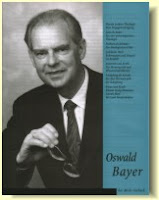
But this is only half of the story. Oswald Bayer writes:
"Luther says in the same passage of the Large Catechism that "faith and God" belong together. This is to be understood precisely in the sense of the "and" in the formula: the God who justifies and the human who sins (deus iustificans et homo peccator)." (Theology the Lutheran Way, 20)
Once we start addressing the sinful man, the other half of the theological equation, things get hairy. The God who justifies is pristine, pure, perfect, complete, objective; how the God who justifies interacts with the sinful man is dynamic, scary, life-and-death. But, until we start to recognizing who the object of our message is, we will not be addressing them, but speaking past them. We will not be preaching Christ, but about Christ.
This does not mean that we stop being Christocentric, rather, indeed, we begin to show how truley central Christ really is. Being Christocentric is not merely to say: "you are a sinner; Christ forgives." Paul is a great example for us. For Paul, Christ is not merely some concept of the forgiveness of sins, rather, Christ is a vital and dynamic reality that brings forgiveness and new life. We read from Paul:
"But if Christ is in you, the body indeed is dead because of sin, but the Spirit is life because of righteousness. But if the Spirit of the One having raised Jesus from the dead dwells in you, the One having raised the Christ from the dead will also make your mortal bodies live through the indwelling of His Spirit in you." (Rom. 8:10-11)
"I have been crucified with Christ, and I live; yet no longer I, but Christ lives in me. And the life I now live in the flesh, I live by faith toward the Son of God, the One loving me and giving Himself over on my behalf." (Gal. 2:20)
"For to me to live is Christ, and to die is gain." ( Phil. 1:21)
"Therefore, we were buried with Him through baptism into death, that as Christ was raised up from the dead by the glory of the Father, so also we should walk in newness of life." (Rom. 6:4)
"So that, my brothers, you also were made dead to the Law through the body of Christ, for you to become Another's, to the One raised from the dead, so that we may bear fruit to God." (Rom. 7:4)
"For the love of Christ constrains us, having judged this, that if One died for all, then all died; and He died for all, that the living ones may live no more to themselves, but to the One having died for them and having been raised. So as we now know no one according to flesh, but even if we have known Christ according to flesh, yet now we no longer know Him so. So that if anyone is in Christ, he is a new creation; the old things have passed away; behold, all things have become new!" (2 Cor. 5:14-17)
"And He said to me, My grace is sufficient for you, for My power is perfected in weakness. Therefore, I will rather gladly boast in my weaknesses, that the power of Christ may overshadow me. Because of this, I am pleased in weaknesses, in insults, in dire needs, in persecutions, in distresses, for the sake of Christ. For when I may be weak, then I am powerful." (2 Cor. 12:9-10)
We are told that God's grace is sufficient because his power is perfected in weakness. This is the major problem behind the Roman Catholic understanding of grace. Catholics see grace as a gratia infusa, an infused grace. Paul tells us that grace is not something that empowers us, rather, grace comes through our weakness so that the power of Christ overshadows us.
The problem with the common Lutheran understanding of grace is that we have not clearly replaced the Catholic understaning with our own. We have a clear definition of God's grace as his divine favor, that is, an external, forensic, "objective ("existing independent of thought or an observer as part of reality" - Dictionary.com) grace;" but we have not clearly defined how God's grace is shown through his internal work in heart, mind and abilities; "subjective ("pertaining to or characteristic of an individual; personal; individual"- Dictionary.com) grace."
I believe Werner Elert offers a very good distinction that should be adopted as the Lutheran replacement for the error of
gratia infusa. We read:
"The change is not effected by the infusion of an object by grace (gratia infusa), but by the personal presence of the Spirit in the Word of grace. Whether this Word is a real force or not can only be answered by those who know they live by grace alone. The righteous shall never perceive it. The poor sinner under sentence of death who has fallen to his knees to be judged hears at this very moment the words, “You are forgiven, rise.” When he finally arises, still shaky and unsteady because his knees seem unable to hold him up, he takes his first steps into the new life which has been granted him a second time. He receives the strength to do it through the perceived Word of grace. No one will ever convince him that his strength was a product of his imagination. The strength to live a new life in grace is the strength of the Holy Spirit." The Christian Ethos, trans. Carl J. Schindler (Philadelphia: Muhlenberg Press, 1957), 217.
That is, a renewed understanding of "subjective grace" in the Lutheran Church is to talk of "the personal presence of the Spirit in the Word of grace."
Though the subject, ourselves, are sinful, fallen, prone to distort, and ego-centric, "subjective grace" in itself is nothing to be wary of. This is because subjective grace does not have the subject as its center, but rather the objective promises in God's Word; it is Christo-centric. It, in a very personal way, deals with and in the subject, but it does not have its basis in the subject; it is not dependent on my own thoughts, feelings, faith, rather, it often works in spite of these things. Bringing back what Paul says 2 Cor. 12, subjective grace puts to death the subject and raises him in the power of Christ; God's grace is perfected in weakness.
The purpose of the pastor is not to lead their parishoners back to themselves (ego-centricism), but to direct them to the promises of God in Word and sacrament (Christo-centricism). As Kurt Marquart says: "It is through these blessed Gospel-channels that the divine life of faith is transmitted to us sinners." "The Third Use of the Law as Confessed in the Formula of Concord." The gospel is not merely a forensic declaration, rather it is also a life-principle that subjectively creates, sustains, and enlivens faith and impels us toward righteousness unto sanctification (Rom. 6:19)
Talk like this as scary for us Lutherans. We cannot point to it, define it clearly, or say it will behave in this way rather than that; "The Spirit breathes where He desires, and you hear His voice; but you do not know from where He comes, and where He goes; so is everyone having been generated from the Spirit." (John 3:8) While all these things are true, we should not fear the Holy Spirit. This is because he is always connected to the promises of God, to his Word, and does not have his basis in the subject.
We have faith in this promise. The Solid Declaration says as much, that we can have faith in the activity of this Word, not based on the subjectivity of self, but on the based on the objectivity of God's promise. We read:
"Therefore, neither the preacher nor the hearer should doubt this grace and activity of the Holy Spirit, but they should be certain that when the Word of God is preached purely and clearly according to God's command and will and people listen to it seriously and diligently and meditate upon it, God will certainly be present with his grace and give, as has been said, what human beings otherwise could neither receive nor take on the basis of their own powers. For the presence, effectiveness, and gift of the Holy Spirit should not and cannot always be assessed ex sensu, as a person feels it in the heart. Instead, because the Holy Spirit's activity is often hidden under the cover of great weakness, we should be certain, on the basis of and according to the promise, that the Word of God, when preached and heard, is a function and work of the Holy Spirit, through which he is certainly present in our hearts and exercises his power there." (SD, Art. II, Par. 55-56)
We need to renew this understanding of subjective grace as "the personal presence of the Spirit in the Word of grace." In neglegence, I fear we have ignored this and have not made clear how the means of grace, through the work of the Holy Spirit, effect our daily lives, strengthening and enlivening faith, keeping us from sin and temptation, and impelling us towards righteousness. May we once again be reminded of these words of the Formulators:
"Moreover, this doctrine points us to the means through which the Holy Spirit wills to begin this conversion and effect it. It also reminds us how these same gifts are retained, strenghtened, and increased, and it admonishes us not to let God's grace have no effect in us, but to exercise ourselves diligently in considering what a grevious sin it is to impede and resist the working of the Holy Spirit." (SD, Art. II, Par. 72)


 "Luther also discovers this kind of performative word in the sacraments of Baptism and the Lord's Supper, as well as in the Christmas story ("To you is born this day a Savior!"), the Easter story, and many other biblical passages. As we have said before, he regards these sentences as promises (promissiones). They are the concrete way in which Christ is present, and his presence with us is clear and certain: it clearly liberates us and makes us certain. I cannot remind myself of this freedom and certainty in isolation; I cannot have a monologue with myself. These gifts are given and received only by means of the promise spoken by another person (and not only by the official priest or preacher), who addresses it to me in the name of Jesus. I cannot speak the promise to myself. It must be spoken to me. For only in this way is it true. Only in this way does it give freedom and certainty.
 "What this certainty is all about is clear from a short passage in the Lectures on Genesis that Luther virtually offers as a theological legacy: "I have been baptized. I have been absolved. In this faith I will die. No matter what trials and problems confront me, I will not waver in the least. For he who said: 'The one who believes and is baptized will be saved' (Mark 16:16), and 'whatever you loose on earth will be loosed in heaven' (Matt. 16:19), and 'this is my body; this is my blood which is shed for you for the forgiveness of sins' (cf. Matt. 26:26,28), cannot lie or deceive. This is certainly true." In the Lectures on Galatians (1535) Luther writes, "And this is the reason why our theology is certain: it snatches us away from ourselves and places us outside ourselves (nos extra nos), so that we depend not on our own strength, conscience, mind, person, or works but on what is outside ourselves (extra nos), that is, on the promise and truth of God, which cannot deceive.""