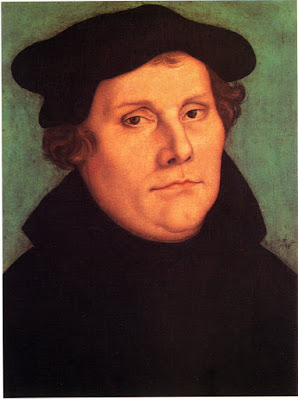
-Wir sein pettler. Hoc est verum.--"We are beggars. This is true."--Martin Luther-

_______________________________________________
[ Home ] [ Originals ] [ Words of Ones Wiser ] [ Odds and Ends ]
Showing posts with label Helmut Thielicke. Show all posts

Friday, January 9, 2009

The Indicative and Imperative Nature of Faith and New Life

This is a section out of my senior thesis on sanctification. What it addresses is the seemingly conflicting scriptural portrayal of rebirth and renewal as being, at one time, solely the work of God, and at another, an imperative placed on man to conform to God's will. It is a matter of resolving indicative and imperative. Various Lutherans have addressed this issue, namely, Paul Althaus, Helmut Thielicke, Adolf Köberle, and to a certain extent, David Scaer. Helmut Thielicke, though, is the one who really hits the nail on the head in the first volume of his Theological Ethics. I have previously written on this topic in my post The Word, Communication, and Sanctification.

We heard a little on this topic from Paul Althaus in the post Althaus on Faith and Command. There are a couple of things in his portrayal that are not quite correct. 1) Althaus talks of: "Insofar as it is God's gift." When talking of indicative and imperative, we cannot say: insofar as it is indicative/ insofar as it is imperative. We have to affirm that it is, at the same time, fully indicative and fully imperative. 2) Another problem with Althaus' portrayal is that he talks of rebirth and renewal (faith and new life) as being, from the standpoint of God, indicative, and from the standpoint of man, imperative. Indicative and imperative is not a matter of perspective, as if man simply acts and thinks as if it were all his work, while in reality it being solely the work and fruit of God. Paul makes it clear that when man acts in autonomy from acknowledgment of his total reliance on God's grace, he acts in rebellion to God. We hear from Paul:

"Work out your own salvation with fear and trembling, for it is God who works in you, both to will and to work for his good pleasure" (Phil. 2:12-13).

"So, then, it is not of the one willing, nor of the one running, but of the One showing mercy, of God" (Rom. 9:16).

God tells us: "My grace is sufficient for you, for My power is perfected in weakness" (2 Cor. 12:9).

When God says "weakness," he does not mean, those who are especially deficient in themselves, rather those who recognize that without Christ, the Vine, they can do nothing (John 15:5). But we, at the same time affirm, "[We] can do all things through him who strengthens [us]" (Phil. 4:13). When we look at the subject of Christ's beatitudes compared to, say, the Pharisees, the difference is not that the Pharisees are stronger, etc., rather, it is the poor in spirit, the mourning, the meek who recognize their total dependence on God's grace, this is why they are called blessed; we are all πτωχοι, literally, beggars in spirit, and yet, in this, we are blessed!

The Lutheran understanding of faith is a perfect example of the indissoluble connection of indicative and imperative. Emil Brunner writes: "The Word of God and the word of faith are inseparable. It is not God who believes but I myself who believe; yet I do not believe of myself, but because of God's speech." (Man in Revolt: A Christian Anthropology, trans. Olive Wyon (Cambridge: Lutterworth Press, 2002), 67.) Faith is at one and the same time completely the work and fruit of the Spirit of God, working through the Word, and yet, it is also my response to God's Word, God's claim on me. Faith is never, whether at the outset, in the midst, or at the end, a fruit of anything that is in me, and yet it is I who believe, it is I who say "yes." The Formula of Concord can even say that we "accept the offered grace." (SD Art. II, Par. 83) This is not inappropriate language if, and only if, the relation of indicative and imperative are understood correctly.

(You are not able to read this from a feed, you must come to the blogspot site.)
The Indicative and Imperative Nature of Sanctification

Sunday, October 26, 2008

Only Time Will Tell

Here are some very interesting thoughts from Helmut Thielicke on the relation between person and structure. I am ever amazed at the timelessness of much of Thielicke's writing. Right now, at this very moment, this is the very ideological and anthropologic struggle that is going on in Iraq. It is a reflection of the old proverb: "You can lead a horse to water, but you can't make him drink." Only time will tell how this relation between person and structure will play out.

"Nevertheless, it is also a fact of experience that new structures can change the awareness of men and therefore men themselves. While it can be very dangerous to introduce a democratic system of government before people are ready for it, in some cases the system can itself produce the necessary maturity. Similarly social legislation can foster a respect for humanity and thus help to engender a new state of mind. It is thus correct that structures can change men and open them up to a recognition of their neighbors as fellow-men.

"All the same, one cannot infer from this that the causal relation of "first the person and then the structure" may be reversed. Instead we must ask: Who is pressing for structural change, who wants this first, perhaps by immediate revolution, and therefore who is not ready to begin by creating intellectual readiness for the new structures? Of the initiators at least we must say that they can will the new structures only because their own consciousness has reached a point where their structural postulates are possible.

"If, then, structural changes can change men, the revolutionary or reforming pioneers at least must have been changed or, in some sense, "converted" before they could work out their program of structural change. If not, the role of Karl Marx is impossible to understand.

"In the heads of the elite, then, there must have formed a conception of the relation between person and structure. In other words, they must have developed a specific understanding of man which has normative significance for this relation. This understanding will either respect man as unconditioned and see him as an end in himself or it will treat him as the mere bearer of a function and thus evaluate him pragmatically. On this alternative will depend whether man is made for the sabbath (i.e., institutions) or the sabbath for man (Mark 2:27)."

-Helmut Thielicke, The Hidden Question of God, trans. Geoffry Bromiley (Grand Rapids, MI: Wm. B. Eerdmans Publishing, 1977), 83.

Friday, October 24, 2008

The Age-Old Myth of Change

I thought these words from Helmut Thielicke express well many of the things many are being fascinated with lately. It is really one of the more human tendencies to dream of change. These words could probibly be read a thousand years from now and mean exactly what they did in the mid twentieth century.

"Utopians have a mobilizing power because they measure the present by the standard of imagined perfection and they condemn it in the name of this standard. They thus give rise to criticism and protest. They do this even when as goals they have no sharp contours but are simply the object of obscure pressure with no clear end in view. Even in this case they trigger the idea of a dialectic of the negative which will later of itself lead from protest to more clear-cut goals.

"Those who see the future in this utopian way, and who are thus critical of the present, can easily play an avant-garde role and downplay all others as reactionaries. Even if they are negative and destructive, few connect this with carping spirit. The shapers of public opinion seem to think that they must be highly visionary and open to the future if they can leave the present and judge it at such a distance. If this were really so, they would be proved right by the future when it comes and they would thus achieve lasting stability. But this is not so. Nothing is more transitory than their programs. Some day a historian ought to write a history of avant-gardists and their criticisms, but I fear that he would need a slow-motion camera to do so. For the fads rise so quickly and then disappear again that the normal organs of sense, even those of a historian, cannot register them. And how comical the idols of the past are when we look back on them."
-
-Helmut Thielicke, The Hidden Question of God, trans. Geoffry Bromiley (Grand Rapids, MI: Wm. B. Eerdmans Publishing, 1977), 76.

Friday, October 17, 2008

Lutheran Quote of the Day: Thielicke on Identity

First we heard from Piotr Malysz on Identity
Second we heard from Oswald Bayer on Identity
Now we hear from Helmut Thielicke:

"The worth of the self is decided by whether the alien factor to which it is related is above or below it. If it is determined by what is below it, its own rank accords with this. The man who is controlled by things is himself drawn into the world of things. Only he who has the alien dignity which being in relation to God confers can escape the enslaving grip that values him as a thing and drops him when he no longer has utility as such. Here alone do we find the protection, the impregnability, and the sacred privileges which man has when he is recognized as the bearer of an alien worth. Even when he ceases to be useful, he is still the one whom God created. He is still, in the Old Testament term, the apple of God's eye. God himself offers protection, so that to touch him is to touch God.

"Similarly in the New Testament the dignity of man is not found in outstanding people, in the great examples of the race, in the genius or moral hero, but in the lowly, in those who need mercy, in the ptochoi, in the extremes of the opposite and darker side.

"The hidden Christ encounters us in the hungry, homeless, naked, empty, and imprisoned. He makes himself the brother of all these. To receive or visit or feed or clothe them is to do it to him. Along the same lines Paul can speak of the inviolable dignity even of those who want to restrict Christian freedom and lay burdens upon us. Christ died for them and therefore we are not to get angry with them (Rom. 14:15; 1 Cor. 8:11). The alien dignity is what makes them sacrosanct.

"Here, then, man is not related to self or things or his utility but to the glory of God which wills to manifest and magnify itself in him. He is sheltered in the alien righteousness of Jesus Christ. God wills to see him in his Son. As, therefore, he has infinite worth in the eyes of God, so he is given true humanity in the eyes of men. The humanity of the Son of God who calls us brethren is hidden and shamed herein, but it is shamed and honored precisely in its hidden dignity.

"It is not true, then, that man becomes small because he is a servant, that the excess of God's glory presses him down. God is not like the oriental despot who shows his greatness by degrading the slaves around him. The idea that the greatness and absoluteness of God means the littleness and devaluation of the men related to him is a false one. The very opposite is the case. The greater the object to which man is related (so long as this object is God himself and not a superior created entity which relativizes man), the more unequivocal his humanity is, and the more inviolable as such. We see this from the marginal cases of humanity which will be understood either as the apple of God's eye or as the playthings of human opportunism.

"The Decisive Insight:

"For us, then, this is the decisive insight. The image of man is always vitally stamped by the alienum actualized in it. This is the key to the remarkable and at first surprising fact that Marxism, in spite of its concern for man, eventually makes of him a thing. It sets him in a false relation and it is then unable to get at him through the autonomy of this relation or even find him. It never sees man at all.

"Man can be shaped by what is below him. In this case his humanity is consumed by the material alienum and at the last we find only the glazed face of inhuman nature or the equally inhuman because uncovered mechanism of dialectical puppets. On the other hand man can be shaped by what is above him, by the alienum of the divine image. In this case the goal is the impress of God's glory which chooses us as its instrument. As the glory of God addressed to us, however, this is, in the traditional vocabulary of Christianity, gratia or grace."

-Helmut Thielicke, The Hidden Question of God, trans. Geoffry Bromiley (Grand Rapids, MI: Wm. B. Eerdmans Publishing, 1977), 63-65.

Thursday, September 18, 2008

Lutheran Quote of the Day: "Jesus’ high-priestly prayer does not stop even when we quit praying."


"No, we cannot base our life on faith. Even the disciples do not live from their faith in that moment when they are battling anxiety and seasickness. They hardly remember that they are believers. There’s simply no time to think about it. That may be put very crudely, but that’s how it is nevertheless! At that moment the disciples do not live from the fact that God is in their thoughts (because he is not!), but they live because Jesus Christ is thinking of them, and the stillness that surrounds his conversation with the Father is filled with these thoughts about his own. Our faith’s grip on the Father may loosen. But he in whom we believe holds us fast in his grasp. Jesus’ high-priestly prayer does not stop even when we quit praying. Thus, there is really no such thing as “Psychology of Religion” because the decisive events between God and me do not happen in my psyche, my consciousness, at all; they occur in the heart of my Lord. Here (and only here) there is constancy and faithfulness; here there is a love that will not let me go, even though my fever chart fluctuates between faith and little faith, between trust and doubt, and no reliance can be placed on my defiant and despondent heart. I don’t need to tell you what a comfort it can be to know that, and how that knowledge can help me survive those times when my own faith is cold and empty and dead and a sealed heaven arches above me."

-Helmut Thielicke, How To Believe Again (trans. H. G. Anderson; Philadelphia: Fortress Press, 1974), 69-70.

Tuesday, September 16, 2008

Lutheran Quote of the Day: Thielicke On the Simul

I just read this today. I think it reflects well what I previously posted on Luther's simul, particularily argument 4.

Helmut Thielicke argues against the misuse of the maxim: peccator in re, justus in spe "sinful in fact, righteous in hope." Namely those who feel one's state of justification makes no difference on one's sin in time.

He writes:

"The false reasoning behind such a thesis runs as follows. As long as we are never anything but sinners who have received mercy, nothing really changes in our existence as sinners. Inasmuch as we have to pray each day "forgive us our trespasses," we must continue to be perfectly intact trespassers. The only thing that changes, according to this view, is our relationship to our trespasses and sin: they can no longer seperate us from God. We may therefore accept-- in a sense in which Luther definitely did not intend it-- the tranquilizing imperative: "Sin boldly!" [Pecca fortiter!]...The miracle of the Holy Spirit would then relate only to the sphere of man's "inwardness"; outwardly everything would remain unaltered." (Theological Ethics; Foundations. trans. William H. Lazareth. Philadelphia: Fortress Press, 1966, 41.)